


Your complimentary articles
You’ve read one of your two complimentary articles for this month. To have complete access to the thousands of philosophy articles on this site, please
You can register for a free account to have four complimentary articles per month. We will occasionally email you a newsletter, from which you can unsubscribe at any time. We do not sell personal data or otherwise disclose personal information to other organisations.
Articles
Does Feminism Need More Than Liberalism?
Vanessa Yeung considers feminist responses to Rawlsian liberalism.
In most modern liberal democracies, women have the same legal rights as men, such as the right to vote, own property, and to seek employment. Yet, beneath a veneer of equality, deep-seated domestic power dynamics and patriarchal norms persist. This raises a fundamental question for feminist philosophy: Is liberalism enough?
At its core, liberalism champions the individual’s autonomous choice and wants this freedom equally for all. If liberty means liberty for all, then it means equal liberty for women and for men. Why then is there any need to be a feminist, when one can simply be a liberal? However, if we anchor our definition of liberalism to that popular version developed by the late John Rawls, then some modern feminist political philosophers, most notably Catharine MacKinnon and Susan Moller Okin, will say that liberalism isn’t good enough.
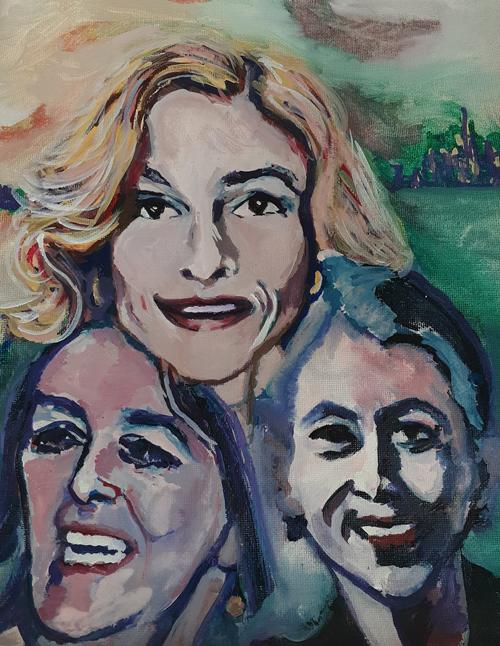
Nussbaum (top), MacKinnon (on the right) and Okin (on the left) by Gail Campbell 2026
Rawls’s Liberal Utopia
John Rawls was an American political philosopher who famously advocated for an egalitarian form of liberalism. He argued in A Theory of Justice (1971) that the just society is one that people would choose even without knowing what position they would occupy within it. He describes a thought experiment in which rational people design their future society while behind ‘a veil of ignorance’, which hides from them anything about their gender, wealth, race, or other background. For Rawls, this choice in these circumstances would create a presumption in favour of an equal society. He argued that two fundamental principles would naturally arise. Firstly, every person would have an equal right to a basic scheme of liberties (the ‘equality of opportunity’ principle); and secondly, social or economic inequalities would only be allowed if they also benefitted the least advantaged members of society (this he called the ‘difference principle’).
Together these two principles allow that inequality can be acceptable – if everyone benefits by it, and an unequal distribution of resources does not reduce any citizen’s basic rights and liberties. Rawls argues that individuals behind the veil of ignorance would vote in favour of these two principles, so that no one would be radically disadvantaged once they enter the game of life, as even the person in the most difficult starting position will still be empowered to succeed better than in other systems (this is the difference principle). In this sense, Rawls’ support for fair opportunity suitably accommodates general feminist ideology. Indeed, this basic framework for equality of opportunity initially appears perfectly compatible with feminism, as both men and women would equally thrive in Rawls’ vision of an ideal society. Behind the veil of ignorance, it would be rational to choose political institutions that protect women’s rights, since citizens could as likely as not be women themselves when entering society. So it seems that the principles of fair opportunity, equality of basic liberties, and the idea of the ‘veil of ignorance’ do strongly align with feminist principles. However, some feminists view Rawls’ liberalism as overlooking justice within the family.
Rawls presents his stance on feminism through ideas on justice within the family. The problem comes down to the traditional distinction between the public and private spheres. Rawls seems to assume the family is non-political, and so categorised as part of the private sphere. Unfortunately, removing the family unit from the world of politics could imply that families are not required to follow the Rawlsian (or other liberal) regulations for the public sphere, but instead have the autonomy to make other decisions on how resources are distributed. As a result, women within their families may sometimes remain subordinate and unequal, despite the public sphere operating on strong liberal ideas of freedom of opportunity.
Feminists Read Rawls
New Zealand philosopher Susan Moller Okin raised this issue in Justice, Gender, and the Family (1989), writing that Rawlsian principles are “deeply and pervasively gender-structured,” specifically because gendered social and moral norms operating inside the family are ignored, resulting in problems that fail to be resolved, such as domestic violence. In distinction from Rawls’ position, Okin says the family should be treated as political, because it operates as a social institution involving power dynamics, resource allocation, and diverging interests. And families do play a significant role both socially and politically. Okin also argues against Rawls’ assumption that removing barriers between the public and private sphere is the best way to bring justice to a family unit.
On the other hand, in Sex and Social Justice (2000), Martha Nussbaum defends the idea that liberalism is sufficient for accommodating feminism in social and political relationships, because liberalism “must respect and promote liberty of choice, and it must respect and promote the equal worth of persons as choosers”. She further argues that liberal insights are crucial to women. But she also identifies current international feminist issues that have not been addressed by liberalism, including educational inequality, social norms, and domestic labour. In contrast to Rawls, who moves from abstract rights to the general potential for human flourishing, Nussbaum uses a ‘capabilities’ approach, focusing on equality and fairness based on each person’s inherent potential. Nevertheless, she demonstrates that the capabilities view strengthens rather than replaces liberalism, and can adapt Rawls’ theory by extending his ideas of a just society to include material, social, and educational conditions for women to develop their capabilities. Thus Nussbaum presents feminism through an extended and ‘reformed’ version of Rawlsian liberalism – a solution that apparently fixes the flaws of abstract individualism and the neglect of the private sphere in classical Rawlsian liberalism. Yet despite Nussbaum’s defence of liberalism as being able to accommodate feminism, others argue that her version of Rawlsian liberalism as reestablishing the relationship between the public and private sphere might deviate so much from Rawls’ core principles that it can no longer be classified as a Rawlsian theory.
In complete distinction, Catharine MacKinnon argues in Toward a Feminist Theory of the State (1989) that liberalism is fundamentally incapable of accommodating feminist insights, particularly concerning social relationships, She argues that women live in a society so deeply imbued with patriarchal values that their decisions are not truly autonomous, as liberalism presupposes, since social conditioning has influenced women to generally simply accept male dominance.
MacKinnon’s views mirror Okin’s, to the extent that both say the private sphere is the main source of women’s inequality. MacKinnon cites the cases of human trafficking and sexual harassment to argue that society should sometimes intervene in the private sphere in order to achieve equality between genders. This directly contradicts Rawls’ version of liberalism. However, MacKinnon explores this issue through a more radical lens than Okin, since she also critiques the capitalist structure of society, and emphasises that the only way to finally resolve gender inequality would be to eradicate current oppressive power structures completely, and undertake a complete transformation of society’s beliefs and values.
For MacKinnon, political liberalism is flawed because it promotes only formal freedom, that is, the freedom to make legal decisions. She suggests that by contrast, feminism strives for the kind of freedom that Isaiah Berlin called positive liberty – the active ability of individuals to fulfil their own potential. (This is in contrast to negative liberty, which concerns what a person can do without being obstructed by others). Nevertheless, typical feminists might perceive MacKinnon’s radical ideas as unachievable in our contemporary world.
Conclusions
So can liberalism accommodate feminist insights into social and political relationships? The reformed Rawlsian liberalism put forward by Nussbaum seems the most realistic way forward. Feminism, at its heart, is a profoundly liberal idea, in that it aligns with the idea of the citizen as a free and dignified maker of choices. However, if to be compatible with feminism Rawlsian liberalism requires changes on the lines of Nussbaum’s re-interpretation of it, then one may ask whether it remains Rawlsian (or even liberal) at all. The more radical interpretations of feminism seen in MacKinnon’s argument suggest that reforms in liberalism itself will be necessary to accommodate feminist insights, since its current ideas on autonomy and neutrality are shaped for an underlying patriarchal framework. Ultimately, this debate illustrates that the ability of liberalism to accommodate feminist insights socially and politically may rely on how far it can be adapted to suit feminism’s progressive values.
© Vanessa Yeung 2026
Vanessa Yeung is an A-Level student from Tormead School in Guildford, Surrey.
Advertisement
