



Your complimentary articles
You’ve read all of your complimentary articles for this month. To have complete access to the thousands of philosophy articles on this site, please
If you are a subscriber please sign in to your account.
To buy or renew a subscription please visit Subscriptions.
If you are a print subscriber you can contact us to create an online account.
You can register for a free account to have four complimentary articles per month. We will occasionally email you a newsletter, from which you can unsubscribe at any time. We do not sell personal data or otherwise disclose personal information to other organisations.
The Greeks
Plato’s Myths
Neel Burton asks why the master reasoner turned to launching legends.
Perhaps the most famous allegory in philosophy is Plato’s Allegory of the Cave, in which Plato, via Socrates, compares people who lack philosophical training to prisoners who have spent their entire lives in an underground cave and don’t realise that there is a vast world beyond what they perceive. The Allegory of the Cave does not quite cut it as a myth, insofar as it lacks the sacred dimension that is the core of myth. But Plato did also write ‘proper’ myths into his Socratic dialogues, thereby – and unusually for the time – bridging the sharp divide between mythos and logos : between storytelling and reasoned discourse.
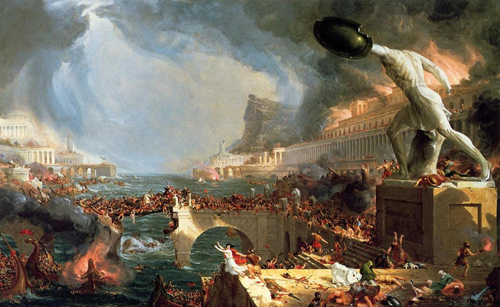
The Course of Empire: Destruction by Thomas Cole, 1836.
…
Advertisement
