


Your complimentary articles
You’ve read one of your two complimentary articles for this month. To have complete access to the thousands of philosophy articles on this site, please
You can register for a free account to have four complimentary articles per month. We will occasionally email you a newsletter, from which you can unsubscribe at any time. We do not sell personal data or otherwise disclose personal information to other organisations.
Articles
When Truth Loses its Witnesses
Mohsen Askari on why not all political narratives should be treated as equal.
I am Iranian living in Istanbul, Turkey. In recent months, I have found myself sitting in rooms with other Iranians, all of us shaped in different ways by the same regime, the same history, and the same accumulated exhaustion. Yet when we speak about what’s happening in Iran, it often feels as if we’re describing different countries. One person sees resistance, another sees foreign manipulation. One sees the collapse of a dictatorship, another sees the danger of national humiliation. One sees war as the terrible price of liberation, another sees it as proof that liberation cannot come through bombs. One sees the Islamic Republic as defeated, another repeats its language of victory. One person speaks of ‘the people’, another asks, “Which people – and who gave anyone the right to speak in their name?”
This is not just ordinary disagreement. It produces a deeper shock. If people who speak the same language, who have lived under the same political order, have inherited the same wounds, and watched the same events unfold, cannot agree on what’s happening, what hope is there for historical truth? If even the present is already broken into incompatible accounts, can we possibly say we know the past?
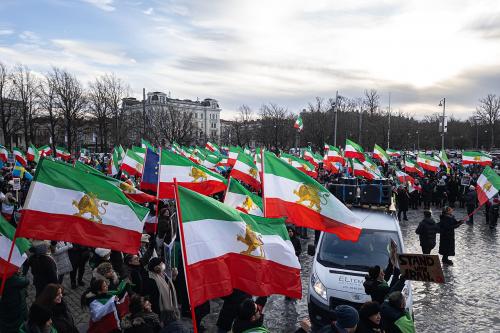
Protest Gothenburg © Crannofonix News 2026 Creative Commons 4
Relativism Conceals Corruption
The apparently easiest answer to this problem is ‘relativism’: everyone has their own truth. Everyone speaks from their own pain. Every story is partial. Every account is constructed.
There is something right in this. Human beings do not experience history as raw data. We do not live through events as neutral recording machines. We remember through fear, loyalty, shame, class, exile, ideology, trauma, hope, and loss. The same event can enter different lives with different meanings. A person inside Iran may experience foreign pressure differently from a person in exile. A parent may hear ‘war’ differently from a young protester. Someone whose child has been killed will not speak in the same register as someone watching from a television studio. There is no ‘view from nowhere’.
But a dangerous mistake hides inside this truth. From the fact that all narratives are partial, it does not follow that all narratives are equal. Some narratives expose harm, some conceal it. Some help us understand a situation more fully, some make understanding harder. Some return agency to the wounded, some steal agency from them. Thus, a victim’s testimony, a regime’s denial, a propagandist’s justification, and a strategic analyst’s cold description of violence, are not simply four ‘perspectives’: they’re reports of four different relations to suffering, evidence, agency, and power, and some are better than others, in various ways. So the plurality of narratives should make us more careful in narrative assessment, not more relativistic.
This distinction matters because political violence does not only attack bodies; through the misinformation that attends the physical violence it attacks the conditions under which truth can be known, shared, trusted, and judged. It kills witnesses. It corrupts language. It destroys evidence. It floods public space with suspicion. It makes testimony sound partisan before it can even be heard. It turns grief into propaganda, and propaganda into ‘common sense’.
Hannah Arendt understood this danger clearly. In her 1968 essay ‘Truth and Politics’ she warned that factual truth is fragile because it depends on witnesses, records, and a shared public world. Mathematical truth can survive without public agreement, but factual truth cannot. If enough people deny that something happened, if records are destroyed, if witnesses are discredited, if language itself is made slippery, factual truth becomes politically homeless, and very short-lived.
Authoritarian regimes know this. Their greatest achievement is not making people believe the official story; it’s making people give up on the possibility of truth altogether. The dictator does not need everyone to say, “The regime is right.” It may be enough if people say, “Who knows? Everyone lies. Every side has its own story.” That is not skepticism. It is surrender disguised as sophistication.
The problem is not that politics contains narratives. It must. No society can remember everything, and no person can tell the whole of an event. The problem is that narratives do things: they classify actors, they assign motives, they distribute innocence and guilt. They decide whose pain counts as evidence, and whose pain becomes noise. Consider that in many authoritarian settings, protest is not described as protest. It is reclassified as infiltration, manipulation, rioting, sabotage, or ‘soft war’. This is not just a minor linguistic shift. Once protesters are seen as instruments of an outside power, they’re no longer seen as citizens with grievances. Their anger no longer has to be interpreted. Their suffering no longer has to be answered. Their deaths can be narrated as the restoration of order. The dead are no longer dead citizens, they are evidence that a conspiracy was defeated. This is a theft of agency. A person who risks their life to speak is transformed into a political puppet. A political demand from the opposition party becomes a security incident. State violence becomes management.
A narrative, then, is not merely a representation of reality, it is an intervention in reality. It can open moral attention, or close it. It can widen the space of responsibility, or narrow it. It can make the victim more visible, or make the victim disappear behind a theory. This is why the question ‘Whose narrative is this?’ is never enough. We must also ask: What does this narrative make possible? What does it make impossible? What facts must it deny? Whose suffering does it erase? Who becomes more powerful if this story is believed?
Bad Language
Miranda Fricker’s work on epistemic injustice gives us useful language for this problem. Testimonial injustice happens when a speaker’s credibility is unfairly reduced because the listeners have been prejudiced. Someone speaks, but their word arrives already discounted. In a political context this discounting can become systematic: the protester is treated as manipulated, the exile as hysterical, the grieving mother as emotional, the prisoner as unreliable. Meanwhile, the official is treated as serious because he speaks the language of order. This is not simply a mistake in listening, it is the political rearrangement of credibility.
Fricker’s second concept, hermeneutical injustice, is also relevant. This is the injustice people suffer when they don’t have the shared concepts needed to make sense of their experience. Something happens to them, but the available public language cannot yet name it properly. This problem is sharpened under authoritarianism because language itself is managed – killing becomes ‘restoring order’, disconnection becomes ‘security’, and so on. People are harmed, and then the language available to describe that harm is stolen or poisoned.
To recover truth, then, is not only to collect facts. It is also to recover the conditions under which testimony can be heard and experience can be named.
A similar linguistic problem appears when some people claim to speak for ‘the people’. In moments of crisis, everyone seems to invoke ‘the people’. Regimes claim to defend them. Opposition leaders claim to represent them. Foreign governments claim to help them. Media channels claim to show what they want. But under authoritarianism, the people are everywhere in speech and nowhere in power. That’s why ‘The people want [whatever]’ is often a dangerous political sentence. Sometimes it’s true, sometimes it’s wishful thinking, and sometimes it’s propaganda – the speaker’s own desire dressed in democratic clothing.
Hearing the People
This leads to a distinction that I have come to think of as ‘democratic audibility’. A population is democratically audible when people can form political judgments freely, communicate them without coercive distortion, and have them registered through credible public channels. This requires more than speech. It requires safety, access, institutions, trust, and the possibility of disagreement without terror.
This idea is close to the late Jürgen Habermas’s theory of communicative action and his concern with the conditions under which public communication can be rational and legitimate. But democratic audibility emphasizes something more basic, and more easily damaged in authoritarian contexts: the possibility of a people becoming hearable politically at all. A culture may be full of voices, and yet still be politically inaudible. This is especially true in the digital age, where visibility is easily mistaken for political audibility. A video can go viral or a hashtag can trend; but circulation is not political authorization, and loudness is not representation. The most visible voices are not necessarily the most legitimate ones – especially when fear, censorship, exile, wealth, algorithmic amplification, and unequal access determine who is heard.
In an authoritarian crisis this problem becomes severe. The person in the country may be unable to speak freely, while the person outside it may speak freely but not represent those inside it. The person with access to foreign media may be treated as the national voice, while the person without internet access vanishes from the record. And silence itself becomes unreadable, as the person who says nothing may be silent from fear, exhaustion, strategy, disagreement, or grief, or many other reasons.
This does not mean that no one can make political judgments. It means we must be honest about the damaged conditions under which such judgments are made. When a people has been deprived of free institutions, open media, secure communication, and basic safety, no claim to speak for them should be accepted without scrutiny.
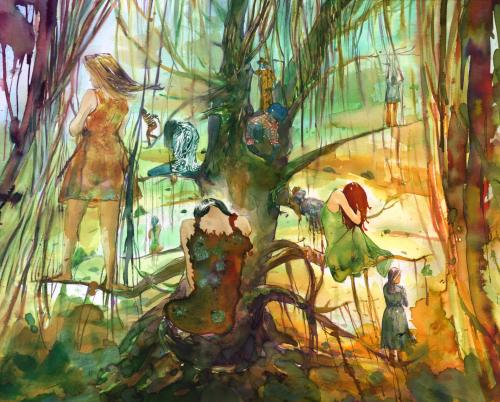
Lost in the Woods of Rhetoric by Venantius J Pinto
Truth & Uncertainty
Truth also needs infrastructure. This may sound strange because we often imagine truth as a matter of mind or character: A truthful person is honest. A rational person follows evidence. A good historian checks sources. All this is right, but incomplete. Truth also depends on phones, cables, archives, courts, hospitals, journalists, witnesses, internet access, translation, memory, and trust. It depends on whether a mother can call her son, whether a video can be uploaded without being deleted, whether a doctor can record a cause of death honestly, whether a journalist can investigate without fear of imprisonment, and whether citizens have the same access to the outside world as officials and propagandists. When a state controls who can connect, it also controls who can testify. When only some people can speak, only some can upload, only some can bypass censorship, and only some can reach foreign audiences, then the public record is unequal before interpretation even begins.
A media blackout, then, is not merely an interruption of communication. It is an attack on the social conditions of truth. It not only stops people from speaking, it also prevents families from knowing, journalists from verifying, citizens from coordinating, and the outside world from hearing. It turns life into uncertainty.
In Persian, the word bī-khabarī means ‘being without news’. But in moments of political instability, this means more than just ‘lacking information’. It means not knowing whether your mother is safe, your brother is alive, your friend has been arrested, or whether the silence in your phone is technical, political, or final. For the philosopher, uncertainty may be a problem of knowledge. For the exile, it may be the sound of a phone that does not ring. And this kind of not-knowing is not empty; it is full of images, fears, guesses, rituals, and distress. People refresh apps. They wake in the night. They scan fragments of news. They interpret short messages as proof of life. ‘We are fine’ becomes both reassurance and a question generator: Fine how? Written freely? Sent under fear? Copied from someone else? Already out of date? The point is that bī-khabarī is not simple ignorance, it’s relational ignorance. It’s the absence of news from someone whose ordinary presence has helped hold your world together. A daily message from a parent is not just information. A photo, a message, a joke, a complaint about the weather, or a reminder to eat properly, may look trivial from the outside, but these small exchanges are how distance becomes bearable, as they’re how a person abroad continues to belong. When that rhythm disappears, the primary question is ‘Where am I in relation to those I love?’ So a blackout does not merely remove data, it removes the ordinary confirmations through which people remain real to one another. This is why the sentence ‘I am fine’ becomes semantically strange under an information blackout. In ordinary life, it may be enough. Under political oppression it becomes unstable: Are they fine, or protecting me? Are they speaking freely, or carefully? Are they safe now, or were they only safe when the message was sent? Does the word ‘fine’ describe reality, or is it a small act of mercy sent across danger?
Here truth becomes inseparable from trust. A message is not only judged by its content, it’s judged by tone, timing, background noise, delay, and the history of the relationship. People learn to interpret silence as evidence. But silence is a terrible witness. It can mean fear, sleep, arrest, technical failure, battery loss, injury, or nothing at all. The mind fills the gap because love cannot leave it empty. This is why not-knowing can be a form of suffering.
In ordinary epistemology, uncertainty is often treated as a lack – a missing proposition. But in political crises, uncertainty can be manufactured, weaponized, and prolonged. To cut communication is to force people into interpretation without grounds. It makes them search for signs while denying them reliable evidence. It makes the imagination do the work of the torturer. In such conditions, truth is not only a proposition, it is also reassurance. It is the daily confirmation that someone exists, speaks, breathes, and remains reachable. When that confirmation is removed, the world itself becomes less stable.
This is why political violence cannot be understood only through the visible act: the shooting, the arrest, the bombing, the lying speech, the bad law. It must also be understood through the damage done to relations. We depend on testimony not as an optional supplement to knowledge, but as a foundation of human life. Almost everything we know, we know because someone told us it, recorded it, preserved it, or made it available. To destroy trust in testimony is to destroy the world.
The work of Nobel Prize-winning Belarusian writer Svetlana Alexievich is important here. Her books do not give us one clear history of Soviet life, war, or disaster – they give us voices, often contradictory, wounded, self-deceiving, generous, bitter, confused, brave. She does not resolve them into a single official account. Yet she also does not treat all speech as equally truthful. The power of her work lies in preserving plurality without abandoning moral seriousness.
This is the balance we need. We must resist the fantasy of one story that explains everything. But we must also resist the lazy pluralism that treats every story as just another equally-viable angle.
Judging the Narrative
In his work on history and silence, Michel-Rolph Trouillot argues that silences enter history at many stages: when facts are created, when archives are assembled, when narratives are made, and when history is finally written. He means that the past is not only lost because time passes, but because power filters what survives. The same is true of the present. What we will later call history is being filtered now. Some voices are being recorded, others are being buried. Some deaths will become statistics, others will become symbols. Some testimonies will be translated, others will remain in private messages, family grief, or silence. Some narratives will travel because they are useful to powerful actors, others will remain morally true but politically weak.
So how should we judge narratives without pretending to be neutral gods? We can begin with a few tests:
First, what facts must this narrative deny? A story that survives only by refusing evidence deserves suspicion.
Second, whose suffering does it make visible? A narrative that notices only the pain of its own side is not necessarily false, but it is morally incomplete.
Third, whose credibility does it deflate even before listening begins? This is Fricker’s warning. If a person’s testimony is dismissed because they are a protester, an exile, a woman, a grieving parent, a prisoner, a refugee, or simply inconvenient to the preferred theory, then injustice is already underway.
Fourth, whose agency does it erase? If citizens become puppets, victims become tools, or protesters become instruments of powers, then something has gone wrong.
Fifth, who benefits if this story is believed? This does not automatically disprove the story, but it does reveal its political function.
Sixth, does the narrative allow complexity, or does it instead demand loyalty? Propaganda usually cannot tolerate mixed feelings. Human truth often begins with them.
Seventh, does the story help us judge, or does it exhaust judgment? Some narratives do not persuade us of a falsehood directly. They simply tire us intellectually until we no longer want to know the truth.
This last point is crucial. The crisis of truth in our time is not just that people believe false things, it is that many people become too exhausted to defend true things. They see an unending stream of competing videos, experts, accusations, corrections, countercorrections, and emotional rhetoric, and eventually they say, “I don’t know anymore.” Sometimes that sentence is intellectually honest. Sometimes it is the beginning of moral withdrawal.
The challenge is to keep judgment alive without making judgment simplistic. This is difficult because politics is complicated. Foreign intervention can be opposed without defending a dictatorship; a regime can be criminal without making every enemy of that regime virtuous; a protest movement can entertain many errors without losing its basic legitimacy; a person can fear war, yet understand why others welcome the weakening of an evil state. A person can be morally authoritative, yet still politically mistaken.
Complexity is necessary. But complexity should not become a hiding place for moral cowardice. (To say that things are complicated is sometimes the beginning of thought; sometimes, it marks the end of responsibility.)
Conclusions
The question is not whether we can escape political and historical narratives. We cannot. The question is whether we can develop the moral discipline of narrative judgment. Such a discipline requires humility, because no one sees everything. It requires courage, because some facts must be defended even when they’re inconvenient. It requires listening, because lived experience cannot be replaced by theory. It requires suspicion, because power often speaks in the language of reason. And it requires care, because behind every political narrative there may be someone whose grief is being used, denied, or forgotten. So in the end, the answer to propaganda is not merely counter-propaganda. It is also not the polite but misplaced relativism that says ‘Every side has its truth’. The answer is harder: it is to listen widely, judge carefully, and refuse to grant moral acceptability to narratives that depend on erasure.
The present will soon become history. But it will not easily become history fairly. Rather, it will pass through memory, media, archives, fear, translation, ideology, and power. Some of what matters most will be lost. Some of what is false will survive. Some of what is true will remain, but without witnesses. That is why we must strongly promote truth as a fragile public practice. In times of political oppression or instability, truth survives not by becoming simple, but by refusing to become indifferent.
© Mohsen Askari 2026
Mohsen Askari is an English instructor and interdisciplinary researcher at Boğaziçi University in Istanbul, writing on language, truth, testimony, education, and political thought.
Epistemic Injustice
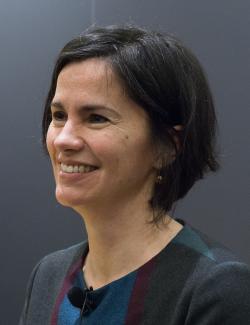
Miranda Fricker © Edmond J. Safra Center for Ethics 2016 CC 2.0
Philosopher Miranda Fricker developed an influential analysis of what she calls epistemic injustice:
Testimonial injustice is when a speaker’s credibility is unfairly reduced because the listeners have been prejudiced against them.
Hermeneutical injustice is the injustice people suffer when they don’t have the shared concepts needed to make sense of their experience.
Find out more: Epistemic Injustice: Power and the Ethics of Knowing (Oxford Univ. Press, 2007)
Advertisement
