


Your complimentary articles
You’ve read one of your two complimentary articles for this month. To have complete access to the thousands of philosophy articles on this site, please
You can register for a free account to have four complimentary articles per month. We will occasionally email you a newsletter, from which you can unsubscribe at any time. We do not sell personal data or otherwise disclose personal information to other organisations.
Books
Cosmic Connections: Poetry in the Age of Disenchantment by Charles Taylor
Roger Caldwell considers Charles Taylor’s philosophical thoughts on poetry.
Romantic poet William Wordsworth defied the stereotypes by living merrily to a ripe old age. His poetry-writing career spanned well over fifty years, and his ‘Lines Written a Few Miles above Tintern Abbey’ of 1798 is one of the best-known poems in English literature. In it the poet feels the presence of
“A motion and a spirit, that impels
All thinking things, all objects of all thought,
And rolls through all things.”
Quite what this motion and spirit is remains tantalizingly obscure. The word ‘God’ nowhere appears in the poem, though it does appear in The Prelude (1850), in tandem with the word ‘Nature’. There he speaks of having “lived, / With God and Nature communing, removed / From little enmities and low desires.” But even there it is unclear how exactly we hear in nature (if we do) what ‘Tintern Abbey’ called “the still sad music of humanity.” (The later, prosier Wordsworth curbs any tendencies towards pantheism in the interests of Christian orthodoxy.)
Certainly we’re far from the mechanical universe of Newtonian science, or from any view of nature which sees it as merely serving human needs. This fits Charles Taylor’s purpose well. In his latest book the Canadian philosopher says that central to Romantic poetry was the task of re-enchanting the world that science had disenchanted, by showing nature not as a kind of mechanism but as a living system of which human beings are an essential part – and thus reconnecting us to the cosmos.
Taylor distinguishes the notion of ‘cosmos’ from that of ‘universe’, the former being the part of the world involved with the lived experience of human beings, the latter being the world as seen from the disinterested stance of science. From this he develops the concept of the ‘interspace’, which is the space of interaction between the universe and ourselves – a domain that is irreducible to either of its poles. The interspace as delineated in Romantic and post-Romantic poetry is the book’s central theme. In Taylor’s terms, a good poem is not just an expression of feeling but an occasion when the cosmos and our grasp of it come together. Philosophy, Taylor tells us, can’t afford to do without the insights of poetry.
The niggling question nonetheless remains: does the poet give us essential insights, or, as Plato once claimed, merely pleasing illusions? Taylor refers to Gerard Manley Hopkins’ poem ‘The Windhover’, in which Hopkins uses the term ‘inscape’ to denote the force which gives shape to a particular being and adopts from medieval philosophy the Latin term haeccitas, or ‘thisness’, to denote the particularity of that being. For Hopkins, the beauty and goodness of the world are captured by the poet in a sort of timeless moment. The grandeur Hopkins finds in the (windhover) bird’s presence is evoked so powerfully in the poem as to bring about a sense of awe. Yet for all that, Taylor writes, is it also possible that the bird is in the end “just a matter of beak and wings and feathers”? Indeed, for another writer, such as Gustave Flaubert, goodness and beauty are not features of the world itself, but only a matter of the artist’s treatment of it. This is, of course, exemplified in his novel Madame Bovary (1856), which in other hands would have been a dull, rather sordid tale of provincial adultery: in his, through the novel’s artistic merit, Madame Bovary, almost despite herself, has become one of the most vital characters in world literature.
Historically, poets in the Romantic period ceased to draw on a common mythological and divine history (such as the Great Chain of Being), and, in a time of decline of a common Christian faith, began to invent their own eclectic mythologies in order to express their vision of the world. I think of Blake’s Golgonooza, of Yeats’ gyres, and of Rilke’s angels that can hold life and death in a single grasp. These poets are explorers of hitherto unexplored regions – as Romanticism progressed, the works became increasingly enigmatic, fragmentary, aspiring to the condition of music, resisting translation into straightforward prose. We get such puzzling phrases as Stéphane Mallarmé’s “flower that is absent from all bouquets.” Here poetry describes not objects in the world, but the effect that such objects have on us. Indeed, in the work of Mallarmé, Taylor sees the poet as “seeking a meaning he’s never quite sure he has found” and which he “may even doubt altogether in moments of severe questioning.” Here ‘what is absent’ is the essential subject-matter. Mallarmé also gives us the image of a tenantless apartment with the Big Dipper in the window reflected in a mirror. Again, it’s what is missing that is most important – the lost contents of the room, the absence of an observer. For Taylor this is a sort of poetry which catches only glimpses, not complete realities, “as one can feel on a hot summer’s day in the forest, under the bright sun, that a revelation is about to break.” Here we are always tantalizingly on the brink of revelation, but it is a brink beyond which we can never pass.
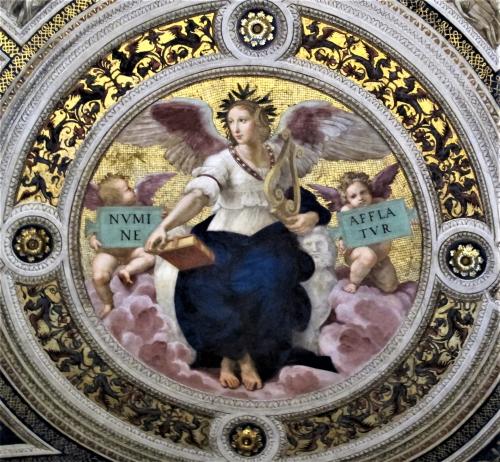
Poesia as allegory of poetry by Raphael
Similarly, in poetry, paradise is usually located either in an irretrievable past or in an impossibly distant future. Taylor quotes Marcel Proust, for whom “the true paradises are those that are lost.” Meanwhile, for Baudelaire, poetry offers us what is “most real” – but he adds that it “is only completely true in another world.” Philosophy, by contrast, when true, is true both in this world and (hopefully) in others. Yet whereas poetic assertions such as Keats’ formulation ‘Beauty is Truth, Truth Beauty’ are rarely the core insights revealed by a poem, in philosophy the assertions (backed up by arguments) are everything. Poetry is after all a fictive art – it tells its truth slantwise, and is not to be taken literally. The philosopher by contrast speaks directly to us, and his or her words are to be taken at their surface meaning. (Poets, it should be noted, rarely make good philosophers. In turn, philosophers rarely make good poets.)
For Taylor, to experience the fullness of life in ourselves we need to feel a connection with nature. Poetry is one means of enabling us to make that connection – in opposition to ‘the scientific-technological stance’. In this running-together of science and technology Taylor is somewhat akin to Martin Heidegger, another proponent of poetic thought. But the real enemy of enchantment is surely scientism rather than science proper. Science itself is not inherently manipulative, nor were the Romantic poets themselves invariably hostile to science. Blake demonized Newton, but Wordsworth put him on a pedestal, and Coleridge and Shelley were enthusiastic exponents of science. Moreover, now, surely a scientific understanding of our sharing DNA with all other life-forms on Earth promotes a sense of kinship with nature of the sort that Taylor recommends.
Cosmic Connections is the work dealing with poetic language which was promised as forthcoming in Taylor’s 2016 book The Language Animal. It amply fulfils that promise. The chapters on individual poets are outstanding introductions to their subjects – admirably well-informed and judicious. As in previous books, Taylor is an excellent exponent of intellectual genealogies. But his concerns spill out well beyond the confines of his overt theme. For example, in his notions of ‘deep space’ and ‘deep time’ he’s concerned to explore what possibilities there are for a full and satisfactory life in what he sees as a secular age. At one point he lets slip his own theistic convictions – in listening to Mozart’s Jupiter Symphony he senses a feeling of music striving towards God – but he does not impress this admission on us: “I can imagine that someone else… would imagine another destination.”
In old age most philosophers attempt to sum up their life’s work and tie up loose ends. By contrast, Charles Taylor, now in his nineties, is expansive – willing to admit his uncertainties and to consider new possibilities. He leaves open the possibility that his interpretation of Rilke’s Duino Elegies is incomplete. He also admits that his account of a poem by Mallarmé may well be wrong; but he persists in it nonetheless, finding no better alternative. In a despairing moment he envisages not only the possibility that poets offer us only fantasies, but also the possibility that “the universe of reductive science is all that there is.” But his conviction is that poetry matters to us by reason of the profound experiences it gives us, and this surely means that we’re not “wasting our time on something mendacious.”
Nonetheless, the doubt, once raised, cannot be erased.
© Roger Caldwell 2026
Roger Caldwell is a writer living in Essex. His latest collection of poetry, Smoking Opium in Moscow, is published by Shoestring Press.
• Cosmic Connections: Poetry in the Age of Disenchantment, by Charles Taylor, Harvard UP, 2026, £19.95 pb, 640pp, ISBN: 978-0674303591
Advertisement
