


Your complimentary articles
You’ve read all of your two complimentary articles for this month. To have complete access to the thousands of philosophy articles on this site, please
If you are a subscriber please sign in to your account.
To buy or renew a subscription please visit Subscriptions.
If you are a print subscriber you can contact us to create an online account.
You can register for a free account to have four complimentary articles per month. We will occasionally email you a newsletter, from which you can unsubscribe at any time. We do not sell personal data or otherwise disclose personal information to other organisations.
Metaphysics
Classical Indian & Modern Scientific Metaphysics
Mansi Tripathi hosts a trialogue.
One thing is common to all systems of thought, wherever and whenever they arise. They all wrestle with two fundamental questions: What exists? and How do we know? I will discuss these questions from three different vantage points: two classical schools of Indian philosophy and modern science. Here are the three perspectives from which we’re going to address these ontological (being-related) and epistemological (knowledge-related) questions:
• The Nyaya school, which from the 2nd century BCE or even earlier sought to achieve liberation from suffering.
• Buddhist philosophers, who deconstructed reality to end attachment.
• Modern science, which seeks understanding, prediction, and control of physical reality.
Despite their different goals, all three traditions face remarkably similar philosophical problems.
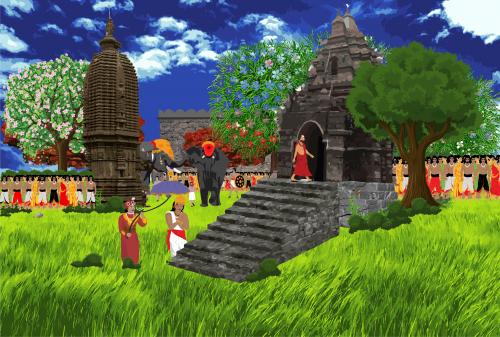
Gauda Kingdom © Zsskala 2021 Creative Commons 4
Part I: What Exists? The Nyaya-Vaisesika View: Things & Properties
Imagine you’re looking at a blue pot. For the combined Nyaya-Vaisesika school, the world is composed of stable substances and their qualities. One of India’s oldest realist traditions in philosophy, it says that you’re perceiving three distinct realities at once: a substance (the pot), a quality (blueness), and potentially an action (if the pot moves). Moreover, digging deeper, the school argues that the universal property that makes all pots recognizable as pots (its ‘potness’) is also real, for without such universals, how could we recognize different objects as belonging to the same category? (There must be something that makes all horses horses, for instance.) This category is also responsible for communication. Without the basic understanding of categories (that is, of groups of things), how could language work?
The Nyaya-Vaisesika system includes seven categories of reality. The first three are, as we’ve seen, substance, quality, and action. These are the things that exist in the ordinary material sense. The next three are universals (like ‘horseness’), particularities (what makes each thing unique), and inherence (the conceptual glue binding qualities to substances). These are real but exist differently from objects: they’re like the rules of grammar that make sentences possible – not visible themselves, but necessary for anything to make sense. Finally, they also claim that even the absence (aabhava) of something is itself real. When you look for your keys and don’t find them, you perceive a genuine absence. That absence causes you to search – it has causal power. So it must be real.
The Buddhist Response: Everything Flows
Buddhist philosophers looked at this same blue pot and saw something entirely different: there is no permanent pot! They argued that what we perceive is only a continually changing stream of momentary events. Just like a movie, we see continuous existence, but it’s actually individual frames replacing each other so quickly that we perceive continuity of being. So for Buddhism, the blue pot is actually discrete pulses of experience that arise and perish in an instant. There is no enduring substance behind them, only the causal stream of reality. So what we call a ‘pot’ is just a convenient label for a causal sequence of momentary ‘pot events’.
The Madhyamaka school founded by the Buddhist philosopher Nagarjuna in the 3rd-century BCE went even further. Nagarjuna claimed that not only are there no permanent things, but even momentary events are empty of inherent existence. Rather, everything exists only in relationship to everything else. A pot exists only in relation to clay, potter, water, fire, and the entire web of conditions that brought it into being. Remove the relationships, and nothing remains.
Modern Science: Structures Without Certainty
Modern physics faces some similar puzzles. Are electrons real things, or just useful mathematical constructs, for instance? Throughout history, scientists have postulated entities such as phlogiston, ether, and caloric that successfully explained observations but later turned out not to exist. Nothing can be said with absolute certainty. Consider this parallel: the Nyaya argued that atoms must exist, because infinite divisibility is absurd, because then you’d end up with something (that is, every physical thing) made of nothing. Many modern physicists similarly argue that fundamental particles must exist to explain observed phenomena. However, instrumentalist philosophers of science question whether ‘electron’ refers to anything beyond our equations or is instead just a concept embedded in theoretical abstraction. Perhaps, today’s electrons are tomorrow’s phlogiston?
Part II: How Do We Know? The Nyaya’s Four-Fold Path
The Nyaya school proposed four means of acquiring knowledge: perception, inference, comparison, and testimony. Their five-step inference to knowledge looks like this:
1. Thesis – This hill has fire.
Why would you say so?
2. Reason – Because it has smoke.
Where else is smoke?
3. Example – It’s like an oven.
What does this imply?
4. Application – Smoke is invariably connected with fire.
What does this mean?
5. Conclusion – That this hill has fire.
The crucial move here is establishing the ‘universal concomitance’ without exception. In this case this is given by the classical saying, ‘Where there’s smoke, there’s fire’. But how do we know there is this universal connection? We can’t check every instance of smoke throughout time.
Nagarjuna’s Critique
Nagarjuna spotted a fatal circularity in this sort of inductive (that is, experience-based) paradigm of knowing. To validate our means of knowledge, we need to know that objects exist; however, to know that objects exist, we need valid means of knowledge. It’s like saying, ‘’I know my eyes work because I can see things” and ‘’I know things exist because I see them.” Each claim depends on the other.
Nagarjuna wasn’t claiming to know that knowledge is impossible, because that would be self-refuting; he was demonstrating that knowledge cannot validate itself.
Science Faces the Same Problem
The classic ‘problem of induction’ identified by David Hume (1711-76) is that science assumes nature is uniform; that laws that work here work everywhere, and laws that work yesterday work today – but that we can’t prove this inductively without first assuming it to be true! We’ve seen the sun rise every morning; but that doesn’t logically guarantee that it will rise tomorrow; we only have our (inductive) experience to go on.
In contrast, the Nyaya says, ‘’Knowledge works in practice; that’s it. That’s enough for its validation.” Scientists generally say the same thing – that if science works (its predictions are accurate, we build planes that fly, phones that connect, and medicines that cure), then that’s enough to prove its based truly on knowledge of the physical world. But does practical success prove truth? Phlogiston theory worked for decades, enabling accurate predictions in chemistry. Yet we now know phlogiston never existed.
Part III: The Unobservable World
All three traditions try to explain entities we can’t directly observe but nevertheless comprehend. The Nyaya school argues that although we can’t see atoms (parmanu), they must exist, as if matter was infinitely divisible, everything would ultimately be made of nothing. We also need atoms to explain why a pebble is smaller than a mountain: simply put, it contains fewer atoms.
However, the Buddhist scholar Vasubandhu (4th/5th century BCE) attacked the very idea of atoms. If an atom has no parts, as the Nyaya school claimed, then how can atoms combine? Six atoms surround a seventh: the central atom must have six different sides where contact occurs. But if it has sides, then it has parts – contradicting the definition of an atom as partless (‘atom’ actually means ‘indivisible’ in Greek). But if atoms are partless, they can’t touch other atoms; and if they can’t touch each other, it means that they can’t combine to form larger objects. So according to Buddhists, the Nyaya explanation explains nothing.
Modern science faces a similar dilemma with, say, electrons. We never see electrons directly, we see tracks in cloud chambers or readouts on detectors. We infer electrons from these observations. But the history of science has many inferred entities, like phlogiston, caloric, and ether, that explain observations, but which turned out to be fictitious. Why can’t it be same for electrons?
The scientific realist says, “Electrons must be real, because they explain too much to be fiction.” The instrumentalist responds to this by saying, “Electrons are useful calculating devices, not necessarily real things.” A Buddhist philosopher would add, “Your attachment to electrons as ‘real’ causes confusion. Use the concept pragmatically without clinging to its ultimate reality, because there is not any rigidly existing electron.”
Part IV: When Theories Die
I’ve mentioned that in the 1700s chemists explained combustion as the release of a substance called phlogiston. This wasn’t fringe science, it was mainstream chemistry. It explained why things stop burning in sealed containers – because the air becomes saturated with phlogiston; and also why burned substances often weigh less – because phlogiston escaped. But then came a problem: some substances gained weight when burned. This implied that phlogiston can have negative weight; but this goes against the concept of matter itself.
Antoine Lavoisier’s (1743-94) oxygen theory then replaced phlogiston theory. Lavoisier explained that combustion isn’t releasing phlogiston, but absorbing oxygen. And we cannot translate phlogiston into oxygen terms – phlogiston isn’t ‘absence of oxygen’ or ‘anti-oxygen’. The two theories have incompatible ontologies: they have different fundamental assumptions about what exists. So phlogiston theory wasn’t refined, it was discarded. This creates the ‘pessimistic induction’ paradox: most ‘successful’ past theories turned out to be false; by induction from this empirical data, our current theories are probably false, too. So how can science claim to approach truth if its history is a graveyard of discarded ontologies? A Buddhist philosopher might reply, “This is what we mean by ‘emptiness’. Scientific concepts are useful tools to understand realities, not ultimate realities. Electrons might be as empty as phlogiston: useful today, discarded tomorrow.”

Science under Judgement by Stephen Lahey
Part V: The Pragmatic Turn
All three traditions can be said to eventually retreat to pragmatism; but their pragmatism differs profoundly.
For Nyaya, the proof that knowledge works is ‘successful practice’: we navigate the world successfully through our knowledge; therefore, our knowledge shows reality. This is a pragmatism that still believes in truth.
In contrast, the pragmatism in Buddhist philosophy says that concepts are empty but conventionally useful. Use them like a raft to cross a river: as necessary for the journey, but to be abandoned upon arrival [c.f. Wittgenstein’s ladder, Ed]. This is pragmatism for personal liberation, not truth.
Scientific pragmatism meanwhile believes theories are only tools for prediction and control. Whether or not they’re true is either unknowable, or, simply put, meaningless. This is pragmatism for a comprehension of reality, not for truth.
In summary, Nyaya seeks truth because truth brings liberation, Buddhism abandons truth-seeking because it causes attachment, while science seeks predictive and technological power regardless of ultimate truth. So these traditions don’t just disagree about the content of knowledge; they disagree about its purpose. To expand a little: for Nyaya, the ultimate aim of knowledge is liberation (moksha): understanding reality correctly frees us from ignorance, thus breaking the cycle of rebirth and suffering. Here, a theory that predicts accurately but doesn’t liberate is worthless. Meanwhile, in Buddhism, knowledge aims at ending suffering through ‘non-attachment’. Accumulating concepts, even if they are correct ones, increases suffering if it reinforces an ego-clinging to those concepts. The goal for these Buddhists isn’t knowing reality, but becoming free from the compulsion to know. And for modern physics, knowledge aims at prediction and control. Science doesn’t promise liberation or happiness, but through rules and mathematics, tries to understand nature and exercise power over it. It offers no ultimate ending.
Part VI: Convergence & Divergence
It seems that despite their differences, all three traditions shift from substances to relations. Nyaya’s concept of inherence (samavaya) tried to explain how qualities stick to substances, while Buddhism replaced substances entirely. Rather, its theory of dependent origination holds that everything exists only through relationships (‘Between what and what?’, one may ask). And modern physics is increasingly trying to describe reality in terms of mathematical structures and relationships; for example, an electron is no longer a tiny ball, but a pattern in quantum fields.
This convergence suggests that perhaps reality isn’t made of individual entities but of patterns, relationships, and structures. If we return to the pot example, the pot ultimately isn’t atoms arranged pot-wise, but a stable pot pattern in the flow of change. Even the particles it’s made of aren’t particles as we know them, but persistent structures in an ever-changing quantum field.
What These Traditions Teach Each Other
So can we compare these projects? Their different aims shape what counts as success. For Nyaya, quantum physics is pointless if it doesn’t reduce suffering; for Buddhism, any theory that unnecessarily increases conceptual complexity is harmful; and for science, talk of liberation is meaningless without tests for truth.
The Nyaya-Buddhism debate lasted a millennium precisely because each had sophisticated responses to the other. When Nagarjuna showed that knowledge can’t justify itself, Vatsyayana showed that the distinction between knowledge and objects doesn’t need justification, so asking for that justification is pointless because the distinction between knowledge and objects is the precondition of all practice. We don’t prove our eyes work before using them; their proof is in their successful use.
This ancient debate anticipates modern philosophy of science. The logical positivists of the early twentieth century tried to ground science unproblematically in observation; but Thomas Kuhn (1922-96) showed that all observations are theory laden. We see through our conceptual lenses. Meanwhile, the realist says theories work because they’re true; the instrumentalist says they’re useful fictions. The debate continues.
The most meaningful understanding I gained was how each tradition could draw lessons from others. From Nyaya, science could learn that knowledge always serves human purposes: the question ‘What is knowledge for?’ cannot be avoided by claiming value-neutrality. From Buddhism, science could learn epistemic humility (maybe?), since today’s revolutionary theory is tomorrow’s discarded mythology (so shouldn’t we hold all theories lightly?). And from science, Indian philosophy could learn the value of systematic empirical testing. Introspection and logic alone cannot reveal the structure of the physical world.
Perhaps this then is wisdom: recognizing that we always see from somewhere, never from nowhere. The ‘somewhere’ of Indian philosophy includes liberation as a goal; the ‘somewhere’ of science excludes it. Neither perspective is complete. We need science’s empirical rigor and technological power, but we also need philosophy’s examination of aims and values.
Conclusion
Perhaps the deepest insight to be gained from comparing these traditions is that human knowledge oscillates between confidence and doubt, between building and dismantling, and between realism and skepticism. We cannot live without ontologies – without theories of what exists. But every ontology eventually outgrows its justification.
As the wheel of knowledge turns, it builds, doubts, dismantles, and then rebuilds again. Oscillation itself might be the deepest teaching.
© Mansi Tripathi 2026
Mansi Tripathi is a PhD scholar at IIM Bodh Gaya, India, working in the area of Organizational Behaviour and Human Resource Management. She enjoys drawing on social theory to understand life.
Advertisement
