


Your complimentary articles
You’ve read one of your two complimentary articles for this month. To have complete access to the thousands of philosophy articles on this site, please
You can register for a free account to have four complimentary articles per month. We will occasionally email you a newsletter, from which you can unsubscribe at any time. We do not sell personal data or otherwise disclose personal information to other organisations.
Continentals
Why Classical Liberals Should Embrace Foucault
Muzainy Shahiefisally argues that Foucault really is on the side of freedom.
The ‘godfather of postmodernism’, Michel Foucault (1926-1984), has long been deemed an enemy by defenders of classical liberalism, at least among those who get their philosophy from podcasts rather than primary sources. Within this milieu, cultural commentators, chief among them Helen Pluckrose, have made a cottage industry out of affixing responsibility for the rise of wokeness squarely on Foucault’s shoulders. Since others before me have taken Pluckrose and her merry band of self-styled ‘liberal humanists’ to task for misreading Foucault, I will not belabour the point here. Suffice it to say that treating Foucault as the progenitor of woke progressivism freezes his worldview to an early phase of his thought and thus caricatures his work to the point of parody.
These characterisations draw their force from early work, when Foucault was still an avowed Marxist. Later in life, especially in his lectures at the Collège de France near the end of his life, Foucault not only shed those sympathies but developed a positive affinity for market economics as championed by the likes of Friedrich Hayek and Ludwig von Mises. The nature of communism, in terms of how it prohibits people from engaging in voluntary market activity and denies individuals property rights over their creations, Foucault came to see as the death of creative life and its replacement by sterile bureaucratic apparatuses of control:
“the idea that the essential function of society or the State… is to take control of life, to manage it… it seems to be that socialism takes this over wholesale. And the result is that… a socialist State… must exercise the right to kill, or the right to eliminate, or the right to disqualify” (Society Must Be Defended, 2004).
Having dispensed with some of the hollow distortions of Foucault that abound today, I want to advance a thesis that’s altogether taboo in contemporary liberal circles: that far from being a menace to classical liberalism, Foucault’s diagnosis of how discursive power operates to rigidify state power places him among the classical liberal tradition’s most perceptive intellectual allies.
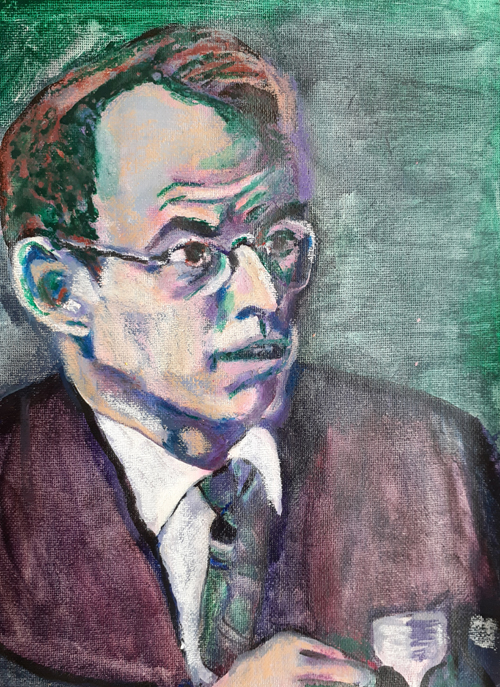
A young Michel Foucault – before he famously lost all his hair. 2026 portrait by Gail Campbell based on an old photo.
Foucault For Freedom!
To substantiate this bold claim it’s worth beginning by demonstrating the distinctiveness of Foucauldian thought in one particular area. Unlike other luminaries in postmodern philosophy and critical theory, Foucault did not believe that ‘power relations’ (his term for the external forces which serve to shape how we behave and understand ourselves) determine who we become. Instead, he insists that power relations are never totalising: that there’s always space for individuals to exercise creative agency to contest social norms, for example.
This aspect of Foucault’s oeuvre allows him to part company with those tarred with ‘postmodern’ or ‘Critical Theorist’ labels. Consider, for instance, Andrea Dworkin, patron saint of the anti-sex left. In her book Right-Wing Women (1983), Dworkin’s central contention is that women do not really possess right-wing beliefs about the traditional behaviour of women. Instead, she asserts, women on the political right espouse the beliefs they do because of false consciousness: specifically, the patriarchal structures which supposedly dictate the terms of our engagement with society have caused women to internalise misogyny.
The liberal humanists who denounce Foucault might expect him to nod along with Dworkin. Yet, a straightforward reading of Foucault’s Birth of Biopolitics (2004) shows clearly that he would demur from Dworkin’s analysis. First, as I mentioned, Foucault in his latter days became a fervent believer in the creativity of the free market. Far from denouncing it as patriarchal and oppressive, Foucault lauded it for “prohibit[ing] any form of intervention and, even better, any form of overarching gaze which would enable the process [of self-creation] to be totalized” (The Birth of Biopolitics: Lectures at the Collège de France 1978-1979). Second, while Foucault did believe that norms can be internalised to produce forms of ‘subjectivation’ (his term for our acceptance of norms which have been thrust upon us by external forces), this internalisation process is not deterministic in the way Dworkin describes. Indeed, given the present pervasiveness of left-wing beliefs among young women, Foucault might describe right-wing belief amongst women as an exercise in creative agency resisting the dominant discourse. Even in Dworkin’s and Foucault’s own day, in light of Foucault’s adamant belief that power relations are never totalising, it is plausible that he would have characterised right-wing women not as products of a patriarchal environment, but as free agents exercising their agency to challenge ‘orthodox’ beliefs. Unlike other critical and postmodern scholars of his age, Foucault was sensitive to the fact that individuals are never simply marionettes pushed this way and that by social forces. Regardless of how powerful social forces might prove, individuals still possess the capacity to go against the grain and assert their own values.
Foucault For Truth!
At this juncture, a sceptic might object that Foucault was a moral relativist, and thus ill-suited to join the ranks of the classical liberal tradition, which emphasises that individual rights are grounded in objectively true moral facts. Such an objection, however, is a thorough misreading of Foucault. Foucault did believe in objective truth. His intellectual output, however, was not concerned with the nature of truth per se, but rather with regimes of truth – that is, with how truth is “produced and transmitted under the control, dominant if not exclusive, of a few great political… apparatuses” (Power: Essential Works 1954-1984, 2020). In essence, a major part of Foucault’s project was structured around how institutions of power (political, scientific, journalistic, or otherwise) produce and disseminate narratives for mass consumption to be adopted as truth by society. This concerned Foucault as the ability to manipulate ‘reality’ reduces the scope for individuals to contest dominant narratives, which in turn confines them to the ordained orthodoxies created by the state and allied institutions.

Daniel Schwen © CC Attribution-Share Alike 3.0 Unported License
Foucault’s theory of truth regimes is akin to George Orwell’s description in Nineteen Eighty-Four (1948) of how the totalitarian State not only disseminates norms to be internalised as truth by its subjects, but how this internalisation also leads citizens to police their neighbours. To be sure, some contemporary liberals are reticent to adopt Foucault’s theory of truth regimes because of its possible implications for scientific knowledge. Yet, this reflexive impulse among contemporary liberals to defend the objectivity of science does overlook the fact that in our age science is a highly politicised discipline. And it bears emphasising that Foucault is not critiquing genuine scientific discoveries. However, he does point out that scientific knowledge is not always pure and can be infected by ideology. In fact, nowhere is the modern regime more visible than in its politicisation of scientific knowledge. Consider for instance how the World Health Organization initially characterised transgenderism as a mental illness in its ICD-10 manual, whereas in its ICD-11 manual this was deemed an outdated diagnosis, with the conclusion that transgenderism is “not actually a mental health condition”. Whether you think the new characterisation is the result of genuine scientific advancement or not, as Foucault would tell us, we ought to be suspicious of the flip-flop. It seems plausible that modern progressive political dogmas, which stress the need to reduce stigma and foster inclusion, influenced the science to produce the paradigm shift. Generally, the fact that scientific institutions are peddling truth masks the reality that the process by which some of this ‘truth’ was produced was inherently political. By concealing the political nature of this influence under a veneer of rationality, these institutions, in Foucault’s words, ‘produce and sustain’ a progressive ideology of power. However, for Foucault, exposing how systems of power manufacture ‘truths’ to cement their power serves to “detach the power of truth from the forms of hegemony, social, economic, and cultural, within which it operates at the present time” (Power: Essential Works 1954-1984, 2020).
Foucault For President!
Indeed, strip away the jargon Foucault developed , and he begins to sound downright Madisonian. One-time US President James Madison (1751-1836) argued for the separation of legislative powers to prevent the concentration of powers in the same branch of government. But whereas Madison was concerned with power in the political sense, Foucault was concerned with power in the ideological or intellectual sense, and so was equally keen to avoid the construction of regimes of truth which serve to reinforce ideological hegemony and reduce the possibility of pluralism. So although he may have adorned his insights with philosophical abstractions, Foucault preached a message of pure liberal vigilance. For him, the maintenance of freedom and pluralism in thought hinges upon our distrust of power, especially when it claims to speak for truth.
However, Foucault’s insights do not simply provide liberals with a warning to be wary of institutions which seek to unilaterally define the borders between truth and fiction. Indeed, his theories also equip liberals with the tools to combat utilitarian government initiatives and egalitarian philosophical discourses, which also trample individual rights.
In Volume One of his History of Sexuality (1976), Foucault began to note that modern life was increasingly typified by government initiatives to assume supervisory control of peoples’ lives by attempting to develop “techniques for achieving the subjugation of bodies and the control of populations”, which he termed ‘bio-power’. Bio-power marked a shift in the techniques systems of governance deployed to maintain control over their subjects. Systems of governance were previously characterised by their exercise of ‘sovereign power’, by which Foucault meant a law-maker’s ability to decide issues of life and death for their populations. However, bio-power functions to ‘administer life’ itself, and dictate the terms for its long-term flourishing. Thus, Foucault states that the justification for instance of the death penalty under a regime of sovereign power, which focussed on a crime’s enormity, became outmoded. To continue justifying it, the death penalty had to be re-characterised in terms of denouncing the criminal as monstrous, so having society view him as a biological threat to its overall safety.
Already we can begin to see how Foucault’s notion of bio-power can be of service to classical liberals: it exposes how certain institutions, such as the death penalty, are not premised on objective justifications, but rather on contingent ad hoc rationalisations which mirror the form the power currently assumes. Yet to quote The Cat in the Hat: “But that is not all. Oh no. That is not all!” The concept of bio-power also has contemporary relevance for liberals. For instance, the arbitrary biopolitical rationale that we don face masks, socially distance, and undergo mandatory vaccination so as to safeguard the vulnerable, was commonly invoked by supposedly liberal democracies during the COVID pandemic. So indeed, it was precisely the deployment of bio-power which allowed governments that often crow about their liberal bona fides to curb individual liberties. These governments instituted what Foucault termed ‘dividing practices’ to distinguish between those who cherished individual rather than institutionalised liberties and the compliant herd: the former were demonised as biological threats to collective security, which, in turn, justified their social exclusion and criminalisation.
The biopolitical instinct for the control of bodies also plagues liberalism’s more egalitarian strains. For instance, John Rawls in A Theory of Justice (1971) advanced the ‘Difference Principle’, which states that social and economic institutions ought to be arranged to the greatest benefit of the least advantaged in society, and those inspired by Rawls’ brand of egalitarian liberalism have added content to this vague proposal to rearrange institutions. For instance, Brighouse and Swift argue that parents should not be permitted to spend their (post-tax) income on their children’s education, lest this violate fairness. Thus, parents who value their children’s education higher than the publicly-financed standard, and employ private tutors, or personally instruct their children on matters beyond the curriculum, ought to feel ashamed ('Legitimate Parental Partiality', 2009). On this reading, the radical egalitarian gaze is analogous to what Foucault described as the ‘economy of faults and merits’ observed by a cultish pastor whose subjects were led to believe that exercising any will of their own was evidence of their inherent sinfulness. What’s more, egalitarian liberalism’s claim to act in the name of securing justice for the least advantaged within society would justify deploying the state’s coercive powers to dictate how individuals may use their property to some degree. In effect, egalitarian liberalism permits the state, acting on behalf of the least advantaged, to impose constraints on one’s use of property. Thus egalitarian liberalism places limits on individuals’ abilities to set their own ends.
Foucault For Liberals!
Foucault’s rich analysis of power provides us with tools to expose political formulations which eat away at liberties, but also serves as a constraint for liberalism to use to contain its own excesses. Indeed, Foucault was not the relativist many farcical contemporary interpretations of his work would have us believe. The reality is instead that Foucault was thoroughly liberal in terms of his ethical outlook, declaring in his ‘Security, Territory, Population’ lectures of 1977 that “Peace will no longer come from unity, but from non-unity, from plurality maintained as plurality.” As such, he sought to develop an ethic which would allow “games of power to be played with a minimum of domination.”
Foucault’s pronounced defence of pluralism places him squarely within the liberal canon. In this regard, his devotion to pluralism converges with Isaiah Berlin’s theory of value pluralism. Like Foucault, Berlin stressed that the pursuit of a single political order – socialist, utilitarian, theocratic, or otherwise – inevitably breeds tyranny. Both thinkers recognised the freedom-diminishing effects of failing to recognise diversity in values and ways of life. However, whereas Berlin focussed his intellectual prowess on analysing the ‘monism’ (‘one thought’) generated by totalising ideologies, Foucault dissected the subtle techniques of truth-regimes through which monist systems of governance sustain themselves.
Classical liberals need not fear Foucault. He was a fellow traveller in the liberal project, and shared many of their concerns. But though I have endeavoured to demonstrate this, the only true antidote against contemporary misrepresentations of Foucault is to actually read him.
© Muzainy Shahiefisally 2026
Muzainy Shahiefisally is a Research Assistant at the National University of Singapore Centre for Biomedical Ethics.
Advertisement
