


Your complimentary articles
You’ve read one of your two complimentary articles for this month. To have complete access to the thousands of philosophy articles on this site, please
You can register for a free account to have four complimentary articles per month. We will occasionally email you a newsletter, from which you can unsubscribe at any time. We do not sell personal data or otherwise disclose personal information to other organisations.
Articles
What is Human Experience?: Psychology vs Philosophy
Ayten Nevzat watches philosophy give birth to a science.
How would you explain human experience? This question is addressed by two separate fields, which travel very different paths to get there. Both philosophy and psychology are concerned with humanity – with people and what drives them to suffer, to change, to behave, and to reason. Philosophy gets there via introspection, and psychology via empirical experiment. In this philosophy is the older sibling and psychology the younger, trying to answer questions first raised by the older one. Both disciplines aim to understand thoughts and the self, and the world that they inhabit. From Descartes to Freud, they both ask questions about the nature of the self. For instance, ethics has been explored by philosophers since Socrates and Aristotle, but childrens’ moral development was experimentally investigated by Piaget. Coining another metaphor, we could say that philosophy provides the scaffolding for what’s human, and psychology provides the bricks that build upon it. So let’s look at what it means to be human and our discovery of it through these two approaches.
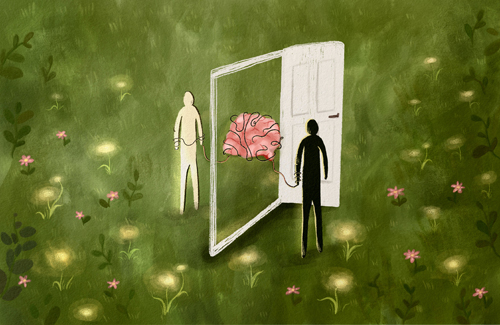
© Oksana Cherepashchuk. Insta: @ksu.artlife
Early Philosophical Psychology
“Know thyself!”, which was said both to and by Socrates, is almost a psychological command centuries before psychology became a science. In fifth century BCE Athens, Socrates would go around from citizen to citizen (mostly aristocrats), trying to gather truth through conversation and debate, and asking them questions. This ‘Socratic method’ of questioning tried to expose contradictions within a person’s beliefs. Socrates’s student Plato, in dialogues such as Meno and Euthyphro, had Socrates say: “I cannot teach anybody anything. I can only make them think.”
Plato, in his dialogue The Republic, developed the theory of the tripartite soul. He divided the psyche into the reason, the spirit, and the appetite. This foreshadowed modern personality theory. Compare it to Freud’s theory of the ego, superego, and it. The divisions are notably similar.
In the Meno, Plato had Socrates remark, “We are not made good by nature, but by training.” The basic idea here is of nature vs nurture, and the effects of the environment on behaviour. It can be compared to conditioning theories, or social learning theory in psychology.
Meanwhile Aristotle, Plato’s student was one of the first people to look at the psyche from a biological and cognitive viewpoint, almost making him one of the founding voices of biopsychology. Long before cognition theory started to give experimentally-derived ideas on how people think, Aristotle wrote, “There is no thinking without an image” (De Anima, Book III, chap.7). He’s saying that mental representations are dependent on the senses – vision in particular.
The Stoics of ancient Greece and Rome said the reason for human existence was Reason (Logos). They further said we have the choice to reinterpret our suffering by applying the balm of our reason. What makes people distressed is not so much their environment, but the stories they create for themselves about it. The Stoic Seneca mentions how humans sometimes deepen their own misery unnecessarily: “We suffer more in imagination than in reality”(Seneca’s Moral Letters to Lucilius, Letter 13, ‘On Groundless Fears’).
In basic terms, Stoics say we can learn to control our emotional responses to gain peace of mind. As Marcus Aurelius said, “You have power over your own mind, not outside events” (Meditations). We cannot control our environment, and often this causes unhappiness; but our rationality lies in how we respond to the changes that happen around us. The Stoics believed that the best way to be human is to feel, think, be tested, do one’s duty, and to be able to reason calmly even when we’re challenged by everything around us.
This leads almost directly to Cognitive Behavioural Therapy, or CBT, which holds that people magnify their problems through their own dysfunctional thinking, but that this thinking can be retrained to work well. It’s also linked to psychological ideas about reconstructive memory and perception, because people interpret what happens to them based on their previous experiences.
The Experimental Study of Mind
Let’s fast forward to the nineteenth century, when psychology becomes a science. In 1879 William Wundt (1832-1920), a philosopher, created the first laboratory for experiments in the field of psychology. Suddenly questions from the philosophers were being answered in empirical ways, and behaviour was being recorded as data.
The word ‘psychology’ is itself taken from the Greek that Socrates and Plato spoke: psyche means the mind or soul, and logos means reason or explanation, such that an ‘ology’ means a ‘study’: so ‘psychology’ literally means ‘study of the mind’. (Compare this to ‘philosophy’, which means ‘love of wisdom’.) Through psychology, the study of human experience now proceeds in ways that are testable and where data can be compared. This is a revelation, because suddenly there are answers! For instance, statistical analysis of the data helps us measure the differences between people so we can determine normality or abnormality in a certain trait. In this way, psychology gives us greater objectivity in analysis. It also gives psychology’s findings intellectual credibility via evidence.
When defining human experience in psychology we use different approaches, such as the social learning approach, the biological approach, the cognitive approach, the social approach, or the behaviourist approach, providing a multitude of paradigms for looking at human behaviour, at how life is experienced, and why it is experienced that way. Neuroscientists map the brain and look at neuroanatomy and neurochemistry to understand the human experience biologically. Using this biological approach, we can see that speech is connected to activity in the brain’s temporal lobe, and talk about its construction specifically in Broca’s Area and Wernicke’s Area, for instance. Or consider behaviourism: B.F Skinner and his experiment with operant conditioning on rats allowed us to study how behaviour can be shaped with rewards and punishments (information that has been adapted and used by institutions to get the desired human behaviour). Or the behaviourist Pavlov, in his classical conditioning experiment looked at how dog’s reflexes are affected by cues, giving us a clue on people’s reflexes. Meanwhile, cognitive psychologists look at thought processes; for instance, how bias, priming and memory affect the way humans live. Moreover, technology such as fMRI scans can help us see the activity in the brain that can help us diagnose neurological disorders such as Alzheimer’s.
Philosophical Conclusions
From all this, we might say that philosophy is the qualitative measure of human experience, while psychology the quantitative measure. The root of philosophy is in thought alone, in the desire to find answers through reason, as seen in Plato and his theories on the soul or Socrates through his questioning to nudge people to think in a critical way that questions their own beliefs, and possibly reshape their framework on life and morality. In contrast, the foundation of psychology is experiments and data, hoping to find answers through the most objective means. It’s not as idealistic as philosophy because it does not look at the way things should be, but at what they are.
When looking into studying human experience, psychology and philosophy are the subjects to choose. They both investigate identity, motivation, and the desire to understand what makes a human being. The difference is, one does it via rational explanation, and the other through science.
© Ayten Nevzat 2026
Ayten Nevzat is a British psychology lecturer and writer with an interest in applying psychological science to real world issues.
Advertisement
