


Your complimentary articles
You’ve read one of your two complimentary articles for this month. To have complete access to the thousands of philosophy articles on this site, please
You can register for a free account to have four complimentary articles per month. We will occasionally email you a newsletter, from which you can unsubscribe at any time. We do not sell personal data or otherwise disclose personal information to other organisations.
Interview
Ulrich Metschl
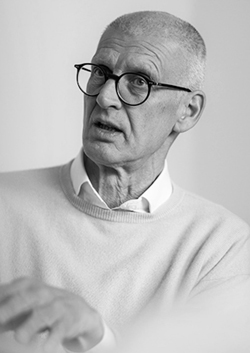
Ulrich Metschl is an associate professor at the University of Innsbruck, Austria. Thiago Pinho talks with him about philosophical collaborations.
Professor Ulrich Metschl’s topics of study are logic and philosophy of logic, ethics of science, and political philosophy. He has published many papers on these topics, as well as a book titled On the Value of Science and the Benefits of Research (2016). He was also my advisor for my postdoctoral research in political philosophy, so I’m excited to discuss with him the role of philosophy in the twenty-first century and its challenges.
In the Continental tradition, most of the time science and philosophy don’t have a good relationship. We can see this, for example, in post-structuralism and its implications for areas like postcolonial studies. For these sorts of theories, science seems like a burden that should be removed, controlled, or, at least, unmasked. How do you see the relationship between philosophers and scientists, especially today? Is there anything we can learn from each other?
Yes, of course. I am absolutely positive that we can and should learn from each other. I think philosophy is not such a freestanding enterprise, and should take into consideration what’s going on in other branches of academia. We can only benefit from learning from science, in particular from the natural sciences, but also from social sciences, or other humanities. I am also slightly reluctant simply to dismiss endeavors like postcolonial studies as being against science. In some sense, these studies can bring a huge benefit to our historical understanding, or our understanding of what is going on in our societies. Migration, for example, has become a major political issue in many countries, and an adequate understanding of its causes will certainly include an acknowledgement of Europe’s colonial past.
In sum, I think that while you’re certainly right that there is kind of a friction between much of what’s going on in Continental philosophy and science, we should not be too hard in our judgment, nor simply say that they’re completely at odds with each other. Even here we can find some sort of cooperation, and that there’s something to be learned from each other.
We live in a world where distrust has become institutionalized. What is the role of philosophy in a world where everything is subject to constant criticism? Can philosophy help address this?
That’s a good question – very timely of course – and I’m not sure how to answer it! A first point might be that certainly the public role of philosophy will probably be a very modest one. It’s for good reasons that we would not want to have philosopher kings, as Plato recommended. Moreover, even when it comes to problems like the rise of the far right, populism, and so on, it’s the task of civil society as a whole to do something about it, because society should find its own way from bottom up, so to say. But I also think that philosophy can chip in a little bit, and make itself useful, if only by trying to clarify the terms and conditions along which public discourse takes place. Improving the standards of reasonable argumentation is sometimes helpful. I hope that philosophy can be at least some help there. But I’m not sure that it will exert much influence or will be able to change the situation if it goes really wrong, and perhaps it’s gone wrong already. So, yes and no, I’d say. Perhaps philosophy can be some help by simply broadening our horizons, by bringing up alternative ways of thinking, and reminding us of good standards for discussing issues. On the other hand, the role should be a modest one. We would not want philosophy to impose itself on society or to become overly authoritative in what it does. It should not decree how societies should be governed, but rather should contribute to an ongoing public discussion on good governance by suggesting fresh ideas or reminding us of critical standards.
It seems the political realm today is a foundation for everything: at least that’s the way people feel on social media. Many non-politicians affirm their politics – whether we’re talking about soccer players, singers, actors, musicians, managers, chefs, nostalgic boomers, or even teenagers. There’s something magical about politics that attracts people. So what is the relationship between philosophy and politics? How do you see it? Is there a strong connection, or is it loose and complicated?
Being myself trained in philosophy, I could only wish that politics would be better informed by philosophy. But again we should not expect too much.
In some sense I think we could even be more interested in politics than we usually are. On the other hand, politics can also be a bit boring. What people really want, and what makes life worth living, is perhaps not politics but being creative, having friends, having a good time, caring for one’s family, having a decent life. Politics, however, is in some sense essential for achieving all that. So what we surely want is that the ideas that are essential for politics, such as freedom or equality – things that are important for us in liberal democracies – are at least sufficiently clear so that our understanding of them is coherent enough to get along with them. We also need some understanding of when these terms become problematic, and of how their meaning may shift over time. For example, when it comes to ‘democracy’, one thing that seems to me pretty clear is that democracies are not immutable, never changing, but rather need to be adapted to new social circumstances. We need some sort of ongoing renewal of our democracies, and of our understanding of democracy: a renewal of democratic procedures as societies change. This of course requires public debate, and that’s a political issue.
Philosophy, it seems to me, has one main advantage over other disciplines, namely that it must think in terms of alternatives. The basic philosophical question seems to me to be: ‘How else could things consistently be?’ This is not meant as an engagement in fiction – not even in science fiction – but rather a call for attempts to think in alternatives. In the political context it means to ask about alternative ways of life individually, and how to organize our lives in new ways collectively.
For example, nowadays, with climate change under way, ideas about alternative ways of governing societies are not exclusively the prerogative of the social sciences. Why? Because science basically informs us about what is the case, but says less about the ways things could be, and least of all how things should be. But philosophy is a discipline that can think in terms of possibilities. It should, of course, strive to think in terms of reasonable possibilities, not just fantastic imaginings, so that it informs society and politics about what improvement might be practically possible. Still we should be weary of paternalistic attempts to overrule what can only be established by public debate. And of course, philosophy must learn from other disciplines and take into account their insights and opinions. One thing we have certainly learned from feminist philosophies, is that even in philosophy we tend to ignore different perspectives for all too long. We definitely should broaden our perspectives and let in other points of view.
According to Immanuel Kant, there is no way for us to directly know the real world, only interpretations and possibilities – what Graham Harman would call ‘conditions of access’. So, we’re forever trapped in a ‘transcendental horizon’ created by language, culture, body, ideology, and other things. Can a philosopher debate about the ‘real world’, or is that old-fashioned pre-Kantian blabbering?
That’s a tricky question. My own view is that, ultimately, you cannot avoid accepting the idea of some reality that we do not create but can try to grasp intellectually. I think realism is in some sense unavoidable, but it takes sophistication. Of course, we should not be naïve realists [who think reality is exactly as we experience it to be, Ed]. But if you ask me what I mean by ‘a more sophisticated version of realism’, I would be hard pressed. It is true that many things are social constructions: Nations, the state, universities, or money, are all examples of social constructions. But even the fact that some concepts seem rather arbitrary – think of colour names, or Nelson Goodman’s example of constellations – does not imply that ultimately there is no mind-independent reality. You might say, “Well, all concepts to some extent are constructions.” I would argue, however, that instead of calling them ‘constructions’, we should see them as verbal instruments to grasp or capture something about ultimately reality.
In some sense, reality may seem elusive because all our efforts seem to leave us with an incomplete picture of the world. Questioning our picture, of reality is very Kantian of course but it’s also a pragmatist position in the vein of Peirce or Dewey. But the idea of doing away with reality altogether – of not accepting anything as being mind-independent – it seems to me is not coherent. In the end, we cannot avoid simply accepting that there is something that underlies objective truth. Think about climate change, for example: trying to deny that it’s a fact by saying “It’s just a social construction” does not take us anywhere. It is because it’s real that we have to do something about it. It’s a fact: accept the fact! How we come to accept it as a fact – how we find out about these facts – is a different issue; but here’s the situation, and I think it’s something we can’t dismiss. So in this sense, it’s indispensable that we accept some kind of realism. But as I said, much depends on how you define that realism. There are all sorts of realisms, and more sophisticated versions certainly allow integrating a [socially] constructivist perspective on some items in our reality.
As we see in many liberal democracies, dialogue is not easy. In general, people take themselves too seriously, and see others as enemies to be ‘destroyed’. Ad hominem arguments are replacing all other forms of discussion: saying ‘You are evil’ rather than why this idea is wrong. And I’m not simply talking about right vs left, but even within the right and the left, and across all of social media. Debates become ‘ideological food fights’, as Michael Sandel called them decades ago. When we think about the public space in liberal democracies, how can this be improved? Is philosophy able to help us with this task?
Again, we should have faith along the lines I pointed out – namely, that philosophy helps us to inform public debates, and clarifies ideas, concepts, and ways to present, to create, and to establish arguments in public space. However, just to make things more complicated, it is not so clear to me that our political discourse really has so much deteriorated. Sometimes we are too nostalgic about the past – due to shortcomings in our memory and also because we forget that in the past political discussions were mostly the privilege of elite groups. It was certainly not the whole population that participated, and large parts of it were excluded. Today, opportunities for participating in political debates are much broader, so it’s easier to add something to them, for better or worse. It is at least some step towards a more democratic public. Does this mean that the standards of public discussions must decline? Not necessarily. Of course, in competing for attention, voices get louder and louder, and this is perhaps not what we would desire for civilized debate. Again, the challenge for philosophy is to add a sober voice, keep some clear-minded path in these discussions, and try to correct conceptual confusions wherever they’re detected. We should not expect too much of philosophy, but we should of course also try to lend a hand to society as much as we can by bringing clarity to the public. I’m not sure that it will ultimately work to the benefit of society, but let’s hope it will.
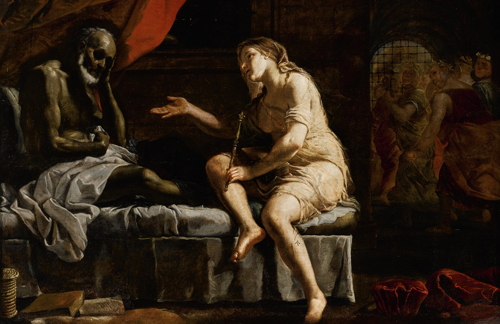
Boethius & the Consolation of Philosophy by Mattia Preti, 1680
It’s both interesting and funny that people expect philosophers to participate in today’s ideological battles, as if they’re looking for a philosophical justification for their side of the argument. They’re seeking legitimation. They want to make their ideology more solid. But sometimes I don’t give them that, and it’s clear they don’t like it. When I try to add a little bit of nuance, or correct certain terms – like when someone says “Trump is a fascist” and I say, “Wait a minute, it’s not that simple. He’s a problematic and dangerous figure, sure, but we need to be careful with our categories because they have consequences” – people often aren’t expecting it. They instead want me to say “Here’s your justification for your political stance. Maybe use Kant here, or Hegel, so you can feel validated.” It’s a tricky situation.
We’re not around to serve partisan ends. I’m not suggesting that philosophy must simply be neutral or impartial, like an innocent bystander. This may not always be possible, and philosophy should not bend over backwards to avoid any position or commitment. But our aim is not to serve certain clients or partial ends, but rather to get the full picture. As you say, the first step here would be to see that things are complicated, in particular when it comes to politics. That may not be to everyone’s liking. Some are put off by the niceties that philosophy tries to add to debates. But I think it’s an important task to which we must remain committed. We should emphasize that we care about details because ignoring the details can be dangerous and can lead to confusion. And, if anything, philosophy should try to avoid confusion and reduce confusion where it exists, instead of creating more of it.
Thanks to social media, people are able to interact in ways that were unthinkable before. I remember that for many decades we complained that people were passive, stuck on a couch eating pizza and drinking beer, like Homer Simpson. But now there seems much more engagement. How do you see the engagement we have nowadays? Should we celebrate it? Are we finally smarter than Homer Simpson?
Can anyone be smarter than Homer Simpson, I wonder? Sometimes I see some over-engagement, but this is a personal perspective. The engagement to which you’re referring is often very personal, and, in a sense, very subjective. People are busy with their own conceptions of what’s important, whereas of course we would want to make them or keep them open-minded. ‘Open-mindedness’ is here the virtue of being interested and curious about what’s going on. The aim is to make oneself ‘objective’. This could counter the type of over-engagement to which you alluded. Personally, I am not so interested in social media and the hype around it; but over-engagement is maybe not the most pressing problem social media create. And they are a way to engage in public debates, at least to a certain extent.
No matter what happens in the world or on TV, people want to share their opinions. The funny part is that often they don’t have any real knowledge and they don’t feel they need it. On the other hand, more people are participating in discussions, explaining their views, and trying to think more critically. Maybe it’s a positive development. I’m not sure.
I’m fond of advocating the suspense of judgment. We should often be more reluctant to come up with our opinions; we should be slower in our judgment, and exert more often a simple suspense of judgment, having the courage to say at times, “I don’t know, I have no idea.” It’s not that one doesn’t care. Sometimes, of course it’s fine not to care about an issue. But if one does care, because it is something that matters, it is important to come up with a considered judgment. If one finds oneself unable to do that, a suspense of judgment is often the best choice. What we see in social media is often quite the opposite of a considered judgment – it’s just something dashed out. So there’s much to be said in favour of a suspense of judgment.
It seems like many are heading down a path of paranoia, creating their own narratives. It doesn’t matter if it’s right-wing or left-wing paranoia, it’s odd either way.
In the liberal tradition the distinction between the private and the public domain is important, because we want to set different standards for the private and the public. But the line between the private and the public, which never was so clear-cut, is getting hazier today. It’s blurred in a sense that it wasn’t in former times. I think what we find reinforced with social media, is a certain kind of overflow from the private into the public. It’s similar to our behaviour when driving. We sit in our private car, getting furious with the other drivers. They, in turn, are getting furious about us, alongside the other drivers. Each is blaming the others for things in ways they wouldn’t if they could communicate face to face. And I think something along these lines happens on social media. There’s no relicence anymore when you’re in your private bubble. People just come up with their very subjective, very spontaneous reactions, which are, as you mentioned, very often ill-founded, or perhaps completely unfounded. But that is a lack of control in a sense, as well as an insufficient understanding of what belongs to the public sphere as opposed to being simply a private emotion, a gut reaction, say.
In your opinion, what is the most important challenge for philosophy today?
That’s also a hard question. Philosophy is not a uniform, homogeneous enterprise, so we have different branches, different orientations, even in philosophy. Generally, I think a real challenge is not to lose sight of what is important for a broader public. What sometimes irritates me a bit, is that, just like any other academic discipline, academic philosophy is highly specialized. That’s fine, but I think it’s really important to have an understanding of what can be transmitted to the public, rather than being bogged down in subtle difficult academic questions that have their own purpose but are not the broader public’s foremost concerns. Of course the very sophisticated discussions in academic journals are an essential part of academic philosophy, much as what we find in mathematics, where we have elaborate theorems proved by experts, and no one except a handful of other experts would understand what they mean and what they’re good for. It’s important to have research going on like that. What I am claiming, however, is that it’s also important to add to the specialists’ perspective a broader perspective more in line with what is of relevance for societies and what’s politically important. So, developing a certain two-sidedness, including a curiosity for the public weal, is I think perhaps really the challenge for philosophy today.
To finish the interview, I’d like to ask you something special. What message can you share with the younger generation of philosophers and social theorists?
I’m not sure that I’m in a position to say anything to a younger generation; but perhaps it relates to what I just said – namely, to try to strive for that broader perspective.
One should not lose sight of how detailed academic research could be brought together with insights that inform public or social concerns. We should keep in mind that we should try to contribute to our societies, and that philosophy should not just be about very sophisticated questions not intelligible to anyone without a PhD. Try to address the public. So that’s what I would say.
• Dr Thiago Pinho teaches at the Federal University of Bahia, Brazil. He has written three books on Social Theory, including Decentering the Language (Zarte,2018), Symptoms (Paco, 2019). He works on topics such as Object-Oriented Social Theory and postcolonial studies. Email him at pinho.thiago@hotmail.com.
Advertisement
