


Your complimentary articles
You’ve read one of your two complimentary articles for this month. To have complete access to the thousands of philosophy articles on this site, please
You can register for a free account to have four complimentary articles per month. We will occasionally email you a newsletter, from which you can unsubscribe at any time. We do not sell personal data or otherwise disclose personal information to other organisations.
Brief Lives
Julian the Apostate (331-363)
Eli Sclar reports on a weaponizer of tolerance.
In 361 AD, the newly-crowned Roman emperor Julian (Flavius Claudius Julianus, 331-363 AD) openly proclaimed his conversion from Christianity to the pagan faith of the ancient Greeks that Rome had previously appropriated. History would soon recognize him as Rome’s last pagan emperor and brand him ‘the Apostate’, an apostate being someone who renounces their faith.
Julian’s conversion to polytheism came at an unusual time for Rome. Thirty-seven years prior, his uncle, Constantine I (popularly known as ‘the Great’) had become the first Christian emperor. His son, Constantius II, followed in his footsteps. Constantine the Great legalised Christianity in the Empire in 313. Julian himself had received a Christian upbringing, studying with the likes of Saint Basil of Caesarea and the Bishop of Alexandria, George of Cappadocia. Yet during his youth, Julian was also introduced to works of Greek literature and philosophy, eventually culminating in his studying to become a philosopher himself, with the personal goal of stopping the spread of Christianity. However, Julian sought neither to persecute the Christians as some of his predecessors had, nor to avenge the pagans for the policies of Constantine and his son. He chose a different method to stop the growth of Christianity – tolerance.
Julian’s early life had been rife with violence. At the age of six, he and his brother Gallus watched as their newly-crowned cousin, Constantius II, assassinated members of his own family whom he deemed threats to his reign. When the dust cleared, the only living male relatives of Constantine the Great were Constantius II himself, his brothers Crispus, Constans, and Constantius Gallus, whom he assigned as Caesars, and the young Julian and Gallus. Julian’s father and older brother had been killed, and Julian himself likely survived only on account of his youth.
In the years that followed, Julian would study the Neoplatonic teachings of Iamblichus in Ephesus, becoming a pupil of the philosopher Maximus, and eventually converting to the pagan faith of his ancestors in 350, although he would not make this known until his ascension to the imperial throne in 361.
Had events played out differently, Julian would have likely lived out his days as a philosopher. Yet this was not to be. Gallus, who had been raised to the rank of Caesar, was beheaded by Constantius in 354 for his mishandling of the eastern provinces. With his brothers dead and no other familial option for an heir, the Emperor turned his sights towards Julian. However, Constantius had no love for his nephew, being suspicious of his loyalty after rumors circulated alleging that Julian had defied exile to meet Gallus in Constantinople before his execution. He raised Julian to the rank of Caesar the following year, then sent him with an army of under 400 men to Gaul to reclaim the province. If his nephew failed, no one could justifiably blame Constantius for his death; but if he succeeded, the Emperor would be able to claim the victory as his own.
Within five years, Julian had restored the Gallic provinces, freed 20,000 Roman prisoners, and expelled the Germanic invaders. Witnessing his success, Constantius sent Julian orders to send his finest troops back to him – over half his 23,000-strong army. The majority of these soldiers were Gauls, whom Julian had recruited. In 360 they mutinied and proclaimed Julian the rightful Augustus. They only relented after supposedly receiving a (polytheistically) divine sign. They then proceeded to sacrifice to the gods. Refusing Julian’s plea to be recognized as Augustus, Constantius prepared for civil war, even while carrying out a campaign against Persia. Finding no luck with his eastern expedition, the Emperor turned back towards Constantinople, yet fell ill along the way, and on the 6th November 361 he died. In his will he accepted the inevitable, passing the empire to Julian.
Now the most powerful individual in the empire, Julian was finally free from censors, and began publishing both imperial edicts and philosophical polemics aimed at weakening Christianity’s influence, although he officially maintained a stance of non-violence. After returning pagan temples that had been ‘requisitioned’ by Constantine, extending privileges he granted to Christian priests to priests of every faith, and issuing an edict proclaiming tolerance for all religions under Roman law. Julian’s first major blow against the Christians came in the form of an imperial edict directed at teachers throughout the empire. In 362, he released what’s now known as his Rescript on Christian Teachers, which articulated the principles that characterized his religious policy.
In this edict, Julian lambasts teachers who simply regurgitate knowledge without explaining how morality or honor plays into things, for Julian saw education primarily as moral formation. Instead, texts from esteemed pagan authors, such as Homer, Hesiod, or Herodotus, whose works were in Julian’s eyes a result of divine inspiration, must be taught in ways that respected the gods. Julian was not against criticism of these works or the men who wrote them; yet he maintained that if they were taught by Christian teachers, they would certainly be taught poorly: for how could Christians grasp, let alone teach, the true nature of these texts? In the edict, he said that those whose teaching ran counter to their own beliefs were doing their students a grave disservice. The same, Julian argued, would apply to a follower of the Greco-Roman gods teaching the gospels. Since they’re paid for explaining works for which they care little, such teachers, in the Emperor’s eyes, “thereby confess that they are the most shameful and greedy of gain, and that, for the sake of a few drachmae, they would put up with anything” (trans. Wilmer C. Wright, 1923). Therefore Julian decreed that Christians must teach a Christian curriculum; by attempting to teach pagan works, they would be committing grave errors. The Emperor also declared the equivalent for Hellenistic educators, but the edict was clearly one-sided: pagan works contained centuries of mathematics, literature, warfare, history, theology, science, and medicine, whereas Christianity, then still a young religion, lacked any major texts outside the Bible, letters from bishops, church histories, and biblical commentary. Any parent wanting their sons to receive an education would therefore of course turn towards a pagan educator, rejecting the small library of Christian works in favor of the full corpus of classical texts.
Julian ended this edict with a demand that students not be turned away from attending a school, nor be blamed for being too young and ignorant to decide what beliefs to follow. He even criticizes those who would overwhelm the youth into following the Greco-Roman gods. And although he thinks the Christians are dangerously wrong, he concludes, “Though indeed it might be proper to cure these, even against their will, as one cures the insane… we ought, I think, to teach, but not punish, the demented.” As a Neoplatonist himself, Julian thought that all the gods of Rome were lesser deities created by a much greater yet distant god, and were designed to shape the matter created by this highest being.
Pro-Jewish & Anti-Christian
During his stay in Antioch in the winter of 362-3, Julian composed his essay ‘Against the Galileans’, perhaps his clearest and most piercing polemic against the Christians. Throughout this work, the emperor labels the Christians as ‘Galileans’, after the region where Jesus was born, emphasizing that Christianity was not a new religion, much less one capable of being universal. Although he acknowledges Galileans using the language and symbolism of their Jewish precursors, Julian finds no basis for Christian thought within Judaism itself. Christianity, in his view, is a heretical sect appropriating the Old Testament.
Julian seems to have had a deep respect for the Hebrew people and regarded them as near-equals to the Hellenes. He attacks the notion that the Abrahamic god would create a being equal to himself: to do so would contradict the core tenet of the Hebrew religion – monotheism. Julian believed that every nation and people is under the care and protection of its own deities: for the Hellenes, there were the Graeco-Roman gods who themselves were split between different geographic locations and ethnic groups. The Hebrews were much the same, except their God jealously demanded absolute loyalty to himself alone from the Jews. For the Galileans to proclaim that the Hebrew God must be worshipped by all, not just the Hebrew people, would also be contrary to the tenets of Judaism. Owing to his Neoplatonist thought, Julian believed that all gods are lesser deities, created by a much greater and distant god, and were designed to shape the matter created by this highest being. Thus the differences of temperament and cultural achievements between the Celts and Greeks, or Germans and Romans, Julian argues, are merely a result of their respective deities’ interference, leading to a system of natural inequality between people.
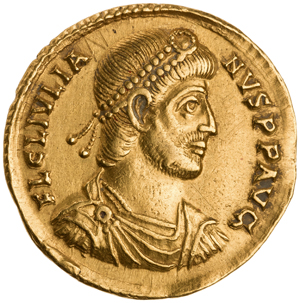
Gold solidus of Julian
The Galilean adoption of the Hebrew god for all people creates an artificial homogenization, a fiction, that all people are equal in all respects, whereas Julian argues that some cultures are naturally better than others in certain activities, such as war, philosophy, architecture, or agriculture. He further explains that the Galileans do not follow the dietary restrictions or the animal sacrifices of their Hebrew predecessors, and purposely misinterpret the Jewish prophet Isaiah to fit the immaculate conception of Jesus. He even asserts that the apostles did not consider Jesus to be God until John declared it after his death.
Despite their monotheism, Julian saw many similarities between the Hebrews and Hellenes like himself: both worshipped in temples, sacrificed animals to their gods, and had purification ceremonies, as well as sanctuaries. He admired their ancient and rich history, seeing them as respectable, albeit unusual, peers of the Greeks. In his letter ‘To the Community of the Jews’, he states that he would end the overtaxation that he witnessed firsthand during the reigns of Constantine and Constantius as well as burn the records so that they may not be used as precedent to harass the Jews.
Although scholars debate whether his philosemitism was exaggerated in order to alienate Christians even further, his admiration for these people seems genuine (in the very same letter, Julian refers to Jewish Patriarch Hillel II as ‘my brother’). He even promised to rebuild their temple in Jerusalem, which had been destroyed in AD 70. By rebuilding the Second Temple, Julian hoped to refute Christianity, as this would disprove Jesus’prophecy about its destruction. Yet such a refutation would never be realized. In 363, shortly after Julian entered Antioch, fires broke out near the site of its construction, likely due to sabotage. The project never resumed.
Conclusions
From Antioch, Julian launched his campaign against Persia in March of 363. This expedition, however, was about as successful as Constantius’s had been. Caught in a withdrawal, Julian was wounded in the Battle of Samarra and died of internal bleeding the next day, on 27 June 363, at the age of 32.
The work Julian accomplished during his brief lifetime provides a fascinating, and one of the last, examples of a Roman noble attempting to refute Christianity, before it completely engulfed the Empire. One wonders what our world would have looked like had Julian’s reign not been cut short. Would Julian’s non-violent policies combating the minority, yet rising, religion of Christianity have been effective? His philosophical insights into the relations between Hellenes and Christians during a period marred by persecutions of both beg further attention. The simplification of his character as an ‘apostate’ masks the uniqueness of his writings, policies, and the world he was born into.
© Eli Sclar 2026
Eli Sclar is a writer and philosophy enthusiast from San Diego.
Advertisement
