


Your complimentary articles
You’ve read one of your two complimentary articles for this month. To have complete access to the thousands of philosophy articles on this site, please
You can register for a free account to have four complimentary articles per month. We will occasionally email you a newsletter, from which you can unsubscribe at any time. We do not sell personal data or otherwise disclose personal information to other organisations.
Continentals
Fun With Deleuze & Guattari
D.E. Tarkington offers some cool conceptual tricks to impress your friends at parties.
The pragmatist Richard Rorty once drew a distinction between ‘public’ and ‘private’ philosophy. This dialectic was clearly at work between Gilles Deleuze (1925-1995), a private scholar focused on self-creation through abstract thinking, and Félix Guattari (1930-1992), a psychoanalyst who was very public and concrete in his activism. What resulted from this collaboration was Anti-Oedipus (1972), a synthesis of the two thinkers and a manifesto that invoked revolution through letting go of all notions of seeking power as a creative individual, and instead seeing oneself as a mere node in a rhizomatic (tangled root-like) matrix of creative exchanges. What they offer to break authoritarian thinking within ourselves is the ‘schizophrenic’ therapeutic process of schizoanalysis. This is a process of building on nomadic flights of thought that perpetually seek to break free from established thinking, even of any rhizomatic matrix it finds itself working in (thereby expanding the rhizomatic matrix!). It’s through these nomadic flights that we avoid the calcification that results in a paranoid center of ideas.
It’s a tough case to crack, Deleuze and Guattari. Their co-authored books include Anti-Oedipus, A Thousand Plateaus (both part of the ‘Capitalism and Schizophrenia’ series), What is Philosophy?, and that other book I have yet to add to my library: Kafka: Toward a Minor Literature. I have sometimes argued that philosophy (especially the more abstract sort) can be a little like someone on psychedelics trying to explain their trip to you; this is especially the case with D&G. Or it’s a little – or even a lot like a Kafkaesque siren a guy experiences in a dream who falls into his arms, then just as quickly disappears, leaving him searching some labyrinthine landscape for her. Yet, I keep coming back for more. My library attests to it. It could be a kind of masochism or self-punishment. Or I could make an analogy with Jacques Lacan’s conceptual model of jouissance – the idea that sex is an experience of pleasure on a conscious level, and displeasure at a subconscious one (being the experience of working deliberately towards a threshold that will take you out of a place you’re really enjoying). As a reverse of this, I could say that for me, reading D&G is succumbing to the push/pull tension of neurotic repeating behavior that evokes displeasure at a conscious level while clearly being pleasurable at a subconscious one. Why would I repeatedly read their difficult-to-grasp books? Perhaps it’s the many conceptual models I’ve found useful along the way – the trees I have embraced without ever being able to grasp the forest, to the extent that my primary influences are those who’ve written secondary texts, like Ian Buchanan, who wrote a useful reader’s guide to Anti-Oedipus and is the main influence on this article. From Buchanan I borrowed (actually stole) some of the conceptual models I’ll feature in this article. My hope is to do as much for you here as Claire Colebrook did for me in her Routledge Guide to Deleuze, and whet your appetite for what is a vast, daunting, and yet inspiring conceptual landscape. I would offer it in a similar spirit to Brian Massumi’s A User’s Guide to Capitalism and Schizophrenia: Deviations From Deleuze and Guattari – as a creative bounce off the conceptual slam-dance that D&G offer, to inspire us to always keep moving, even while standing still (just as Foucault does in his Intro to Anti-Oedipus).
Rhizomes, Nomadic Flights & Paranoid Centers
It was twenty-plus years ago that an entry in a guide to postmodernism set it all off for me. The trigger was reading that there’s a distinction in knowledge between the arborescent – the tree-like, which has a center: think of a ‘Tree of Knowledge’ with metaphysics at the roots and physics as the trunk, and the various disciplines branching out from there – and the rhizomatic, which has no center (it’s a biological term based on the roots of grass). That’s all it took. I always had a problem with finding a center myself. In my youth, I always wanted to bounce around between different disciplines and see what hybrids emerged. I was that cocky. Now D&G gave me license – a license I could hold up against the arborescent model, which to me has always had authoritarian implications. That always features a ‘first cause’ (or ‘core cause’) understanding of causation. This is the understanding that underlies the political right’s take on the world: it’s their paranoid center. And it’s in opposition to this way of thinking that D&G work. As Foucault put it in his intro to Anti-Oedipus : it’s about seeking out and undermining the ‘fascism’ (that is, the authoritarianism) at work everywhere, including, and most importantly, in ourselves.
Let me explain.
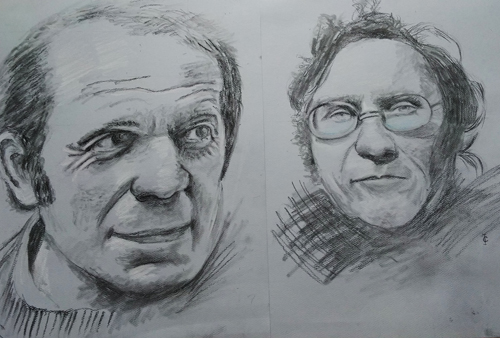
Deleuze & Guattari by Clint Inman
The Paranoid Center of the Oedipal
Anti-Oedipus started for D&G with a mutual agreement with Freud’s early understanding of the subconscious, and a shared disagreement with Freud’s departure from it.
Sigmund Freud (1856-1939) started off by recognizing the general chaos at the bottom of the mind and the base of the brain: the libido or sex drive. Then he turned to what might put it in order. He started to treat the subconscious as if it were like our conscious minds, that is, as if the unconscious mind could put together elaborate symbolic structures to tell the conscious mind something. Think, for instance, of the Freudian dream dictionaries we used to see in the seventies. What resulted is Freud’s Oedipal theory, in which raw psychic energy is channeled towards a supposed subconsciously-desired sexual relationship. However, this theory resulted in creating a hierarchical relationship of its own: psychoanalysis is about an expert (Freud or one of his disciples) casting you, the subject, in the role of a fractured soul that needs to be put back together. And it’s not a big conceptual leap from the analyst/patient relationship, to the relationship of a boss and his employee, or a despot and his subject. Plus, as D&G wrote, the Oedipal theory acted as a misdirect to the extent that it focused all its attention on the family while avoiding the fuller expanse of influences on an individual’s life. So in a very bourgeois way, it distracted from the many psychologically problematic hierarchal relationships in which an individual will find themselves outside of the family – most importantly, those involving capitalism.
It was this disagreement with Freud and psychoanalysis that brought D&G to develop schizoanalysis, which can be seen as a kind of philosophical pinball. They based it on what they call ‘the schizophrenic process’, which is a different concept from clinical schizophrenia. They also took a more biological understanding of schizophrenia itself, and advocated more pharmaceutical approaches to it, since as they saw it, the ‘talking cure’ was at best equipped to deal with neurosis, or more mild mental problems, often caused by bad experiences, but not with psychosis, the more deep-rooted mental problems, which are often brain-dysfunction based. It should be noted that here they were ahead of their time: Anti-Oedipus was published in 1972, while the psycho-biological approach to psychopathology primarily took hold in the 1990s.

Roots © Dreameryonmae 2022 Creative Commons 4
As D&G also saw it, Freud went wrong by averting his attention from the barbarian hoards of the unconscious (the libido and its urges) for the sake of a more orderly, but flawed, understanding of it (his Oedipal theory). They responded by embracing the initial aimless subconscious energy, calling it ‘desiring production’ – their version of the id – based on their observations of schizophrenics who’ve played some part in our cultural history, who seemed to just connect with their environment. They followed through by analyzing how that aimless energy might work its way into the world and produce its effects. One of the main questions they were trying to answer in schizoanalysis was that raised by the Austrian psychoanalyst Wilhelm Reich (1897-1957): What is it about people that means they would seek their own oppression? What they arrived at is a model of desiring production – that which produces purely to produce – working itself into a world where it can only become social production, that can itself turn on and condition desiring production.
Into the World
In order to understand the interaction between desiring and social production, we have to consider the three syntheses of the subconscious (the very domain of desiring production):
Connection, Disjunction, and Conjunction, each of which has an illegitimate use related to starting out with a fixed understanding of what is to be achieved: that understanding being the product of social production or over coding.
You should get connection naturally. It’s about connecting with meaning. For instance, by reading this, you’re basically engaging in a connection that produces meaning for you. Connection is also about a reality that requires we put it together, like a puzzle. It’s the way that when we first perceive anything, it starts with individual data, this data draws us to other data, and all this data fuses into the way we see the world. The catch here, as D&G see it, is when this process draws us to a preordained conclusion.
The disjunctive synthesis is a ‘catch in itself’. As our data fuses together, distinctions emerge – between male and female, black and white, straight and gay, normal and abnormal, etc, etc. This is because, in all those connections being made, there is always the meaning to be derived from ‘this compared to that’. This really becomes a problem when you reach the conjunctive synthesis. This is the ‘me as opposed to you or it’ stage of thought – the point at which you become a subjective being, then fold back into all the incoming data in order to continue the process of synthesis.
Let’s consider some concrete applications of these ideas. I’d start with comparing this synthesis of thought with the romantic process. First, lips contact lips, and connections follow. But the disjunctive gives it away: it’s always that push/pull tension of pleasure and pain that Lacan described sexually in terms of jouissance. The conjunctive reaches the threshold Lacan associated with positive jouissance, and crosses it. We can also see the process of synthesis in the storytelling process. First, connections are formed; disjunctions emerge as the established order is disturbed and chaos is created. Finally, one or more characters land with who they really are, before sinking back into a reorganized world. But at the bottom of all this, is Buchanan’s point in his user’s guide to Anti-Oedipus, that D&G think we cannot get away from this creative dynamic because it’s literally everywhere.
I suspect the theory goes back to Deleuze’s engagement with Immanuel Kant in Difference and Repetition (1968). Here Deleuze starts with ideas from Kant’s doctrine of mental faculties:
Apprehension: the immediate engagement with reality, or some aspect of reality;
Repetition: a function of memory resulting from repeated encounters with a given aspect of reality, leading to:
Recognition: the recognition of what is being apprehended.
Deleuze, however, revamped Kant’s model of understanding, dividing it into the sensible (what is immediately perceived through the senses), the imaginary (a Lacanian concept, referring to the sensible acting on the pre-linguistic mind), memory, and, finally, language-based understanding and/or thought.
It’s not hard to see how the three syntheses apply here: how the connective is at work in our immediate confrontation with reality (this and this and this together); how the disjunctive might emerge in the processing of that information (this as compared to that); and finally, how the conjunctive can turn on the process by informing a subject that places itself in opposition to what it perceives. From this we can also understand D&G’s political agenda, which is to embrace desiring production in its pure and spontaneous state (one could, for instance, become an avant garde artist). This is in order to mitigate the bad effects (the paranoid centers of authoritarian thought) that can emerge as desiring production transforms into social production – that is, as the individual creative mind gets involved with the social world. However, let me give a disclaimer. As I pointed out, what D&G are offering is a conceptual slam-dance, a creative expression with the necessary momentum to get beyond ourselves, managed through multidirectional exchanges of creative energy. It’s not hard to imagine the kind of psychic speed-smear that might emerge from this process; nor is it hard to see the kind of extremes individuals might go to facilitate their creative momentum. It was indeed these extremes that brought D&G to tone it down for the second book in the ‘Capitalism and Schizophrenia’ series, A Thousand Plateaus (1980).
Conclusion & Approach
Confession: If I’ve succeeded at what I set out to do and inspired you to explore D&G further, I will equally have failed you. Should you choose to take on that mission, you will still find yourself as confused as I was: my experience and ‘wisdom’ will be of little help. And it won’t just be a matter of confusion over the original texts, but the secondary texts as well. Since they’re trying to explain the same psychedelic experience being described in the original text, they will likewise require multiple readings. All I’ve offered here is an entry point, a personal description of my experience with D&G and those who have sought to explain them to me.
Still, it’s as good an entry point as any. While I can’t come close to the more scholarly approach of my influences, my twenty-plus years of experience with D&G (and the fact that I stuck with it, or am stuck with it) should give me some license to invite you into the sandbox; that is, to offer you a stepping stone into a conceptual landscape I can’t seem to walk away from. Share the joy, right? At the very least, I’ve offered you a couple of tips on how to approach D&G, in terms of what’s fed me enough to keep me coming back.
At the end of every secondary text is an extensive bibliography, and we may comfortably assume that the author of that secondary text got their understanding of the primary text by reading most, if not all, of those books. This is what distinguishes a scrapper like me from a scholar like Buchanan or Colebrook. Any understanding we’ve gained is not the result of one text acting in a vacuum, but rather, each text deriving its meaning from the part it plays in the general discourse. D&G argue in A Thousand Plateaus, that a book doesn’t reflect the world; it forms a rhizome or root connection with it. To truly get it, or get anything out of it, you gotta work in the overlaps and find your own place in them; and keep testing that place against the text.
There is a poetic, or rather, an aesthetic, about D&G – they have a sense of art or style. We’ve seen this aesthetic in philosophy with many continental thinkers since Kierkegaard and Nietzsche in the nineteenth century. So, even if you don’t get what it’s saying, you gotta love this opening passage into Anti-Oedipus:
“It is at work everywhere, functioning smoothly at times, at other times in fits and starts. It breathes, it heats, it eats. It shits and fucks. What a mistake to have ever said the id. Everywhere it is machines –real ones, not figurative ones: machines driving other machines, machines being driven by other machines, with all the necessary couplings and connections. An organ-machine is plugged into an energy-source-machine: the one produces a flow that the other interrupts. The breast is a machine that produces milk, and the mouth a machine coupled to it. The mouth of the anorexic wavers between several functions: its possessor is uncertain as to whether it is an eating-machine, an anal machine, a talking-machine, or a breathing-machine (asthma attacks). Hence we are all handymen: each with his little machines. For every organ-machine, an energy machine: all the time, flows and interruptions. Judge Schreber has sunbeams in his ass. A solar anus. Judge Schreber feels something, produces something, and is capable of explaining the process theoretically. Something is produced: the effects of a machine, not mere metaphors.”
There’s something cool, even poetic, about someone well-read bouncing around their heads as D&G did. And while I find it useful to occasionally randomly go to some point in the text and work methodically through it, sometimes you just have to let it flow through you, see what catches. As Donald Finkle prescribes in his poem ‘Hands’, in words that apply to continental philosophy and to D&G as well as to poetry:
“Lean back and let its hands play freely on you:
There comes a moment, lifted and aroused,
When the two of you are equally beautiful.”
© D.E. Tarkington 2026
D.E. Tarkington is a maintenance tech for a large campus. He enjoys taking in information from different sources, letting it churn around, and seeing what he can do with it.
Advertisement
