


Your complimentary articles
You’ve read one of your two complimentary articles for this month. To have complete access to the thousands of philosophy articles on this site, please
You can register for a free account to have four complimentary articles per month. We will occasionally email you a newsletter, from which you can unsubscribe at any time. We do not sell personal data or otherwise disclose personal information to other organisations.
Islam & Philosophy
Love & Emptiness in the Sufi Tradition
Medha Ninad Tambe meditates on Rumi, love and self-negation.
What does it mean to love? Is to be loved really to be known? Jalal al-Din Muhammad Rumi (1207-1273 CE), an eminent poet and mystic from the Sufi tradition, would vehemently disagree. Rumi would argue that to love is in fact to enter the unknown: to love is to empty the self of all self-knowledge entirely.
Rumi’s poetry is extensive, and extraordinarily wide-ranging in content, containing a myriad of themes, and meandering through existential ideas from infinity to divinity. Emptiness is one theme on which he comments frequently (albeit often briefly and in passing), weaving it into poems about love, identity, and God. Through considering Rumi’s exploration of emptiness, his criticisms of knowledge as an eventual impediment to achieving it, and his metaphysical musings on interpersonal connections, I will argue that the Sufi conception of emptiness he expresses is in fact, a paradoxical state of infinite fullness – a complete dispossession of self in which we may experience love in its purest form, and thus enter into union with the divine.
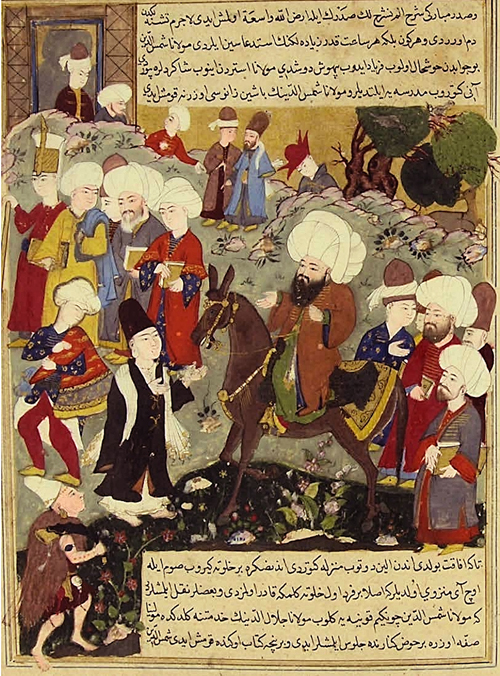
Rumi meeting his spiritual mentor Shams Tabrizi (16th century, Topkapi Palace Museum)
Filling Out Emptiness
Rumi idealises emptiness, claiming that it is in the natural order to strive for it. In the poem ‘Craftsmanship and Emptiness’, he writes that “every craftsman searches for what’s not there” – emptiness – in order to create and ‘fill’. He urges us to not fear the emptiness but rather to ‘rush toward’ it. Further, he claims that the emptiness ‘contains what you need’, and that it is generous in its ‘abundance’. Hence he implies that we must yearn for emptiness rather than cultivating attachments to material desires and entrapments.
Undoubtedly, the way Rumi characterises this emptiness is puzzling. Emptiness is conventionally conceptualised as a lack of something, or more reactively, as a space no longer containing what was previously there. Rumi however adds another dimension, by providing emptiness with an identity of its own. No longer is emptiness simply a residual afterthought of a condition which once was. Instead, he renders it as something in and of itself. Accordingly, he urges in the ‘Emptiness’ poem to ‘ be everyone’ – rather than just being associated with them – then argues that “when you become that many, you’re nothing. Empty.”
Here, Rumi’s idea of being empty is diametrically opposite to a lack or absence. Instead, it is the quality of being filled with many – a near-infinite plurality of identity – which somehow then collapses into an indiscriminate nothingness.
This apparent contradiction is elaborated on as Rumi conceptualises emptiness as a total disestablishment of the self. As implied in ‘Emptiness’, in the ideal state of mind, the identities of ‘everyone’ subsume the individual’s identity, delivering the self to some void of infinitude. Thus we are empty, but only in the sense that we are emptied of ourselves: the emptiness, however, is in truth a fullness so profound that we can no longer discern individual characteristics. Rumi further contemplates in his poem ‘Where Are We?’ that he belongs to himself only so much as “a pen knows what it’s writing”, or “the ball can guess where it’s going next.” In other words, to be truly empty in Rumi’s sense is to belong to something other than ourselves, and consequently lose our own identity entirely. When our identity is thus dissolved, only this invaluable state of absolute fullness, characterised as emptiness, remains.
The Trappings of Knowledge
Here it becomes necessary to consider intention. Can this emptiness be achieved consciously, or is it a state which we must somehow unknowingly tumble into?
Bismillah is Arabic for ‘In the name of God’. In his poem ‘Bismillah’, Rumi explains that priests say “ Bismillah” when offering an animal in sacrifice to God. He then urges the reader to “ Bismillah your old self to find your real name.” The task of chanting Bismillah certainly implies a conscious sacrifice of the old self: to find our ‘real name’ is an enterprise only to be conducted in the perusal of what remains after the self-sacrifice. In spite of the fact that we may lose ourselves in the infinite – “so overcome… [that] all qualities of doingness disappear” (‘Rough Metaphors’) – to realise our full potential emptiness is an undertaking which seemingly must be pursued intentionally. At some point in that undertaking, though, it becomes necessary to consciously discard the self and allow it to be swallowed by the multiplicity of the emptiness. As Rumi remarks, “Only when I quit believing in myself did I come into this beauty… in this ocean of pearling currents” (‘A Dove in the Eaves’).
Eventually, then, conscious knowledge too must be cast away – Rumi laments in ‘The Reed Flute’s Work’ that knowledge is “for total destruction”. He prescribes a state of no knowing as ideal, because knowledge itself has “forgotten about silence and emptiness”. In other words it is impossible to describe (that is, have knowledge about) the ineffable nature of totally emptying the self. Yet conversely, it is tremendously difficult to achieve this emptiness without depending on knowledge. The strain between knowledge and emptiness is a pervasive theme of Rumi’s work, and upon this tension much of Rumi’s poetry precariously balances, often bubbling up in the odd contradiction or inconsistency, between poems.
Knowledge, in the form of language in particular, is well-considered by Rumi as it pertains to emptiness. Yet language is also shown by Rumi to be an impossibly inadequate avenue for revealing or discerning the self. As he notes, “every spoken word is a covering for the inner self” (‘The Night Air’). Yet it is into language that we retreat when confronted with the emptiness which floods within. Rumi implies that in moments of trepidation when facing the infinite void, language is used as a familiar yet limiting crutch, shielding the self from yielding to the necessary emptiness. To truly access the emptiness, however, we must forgo the secure knowledge of language for a communication beyond words – a transcendence beyond description, nearly divine; as he explains, “language does not touch the one who lives in each of us” (‘An Awkward Comparison’). So to reach this universal, unifying ‘one… in each of us’, we must first look beyond the trappings of language, avoiding the temptation to entirely interpret the self through words. In fact, ironically, Rumi the poet implies that words can be dangerous if clung to beyond a certain point of self-realisation. In ‘The Well of Sacred Text’, for example, he cautions us to not ‘fall down the well of scripture’. He then likens the Qur’an and the Bible to ropes in this well, and advises the reader to be wary of holding the rope too long, instructing instead to “let the well rope pull you out. Then let the well rope go” [cf Wittgenstein’s ladder, Ed].The rope of knowledge must be eventually released for us to be emptied. To attempt to tread the bridge of language all the way to the infinite is an errant endeavor.
Preparing Ourselves For The Lover
Finally – by shedding the last vestiges of materialism and extricating ourselves from the comfortable prison of language – we achieve Rumi’s ideal state of emptiness. Rumi fashions this state into various forms, attributing to it a multitude of qualities. The true implications of this infinite emptiness, however, are steeped in love, which is the path to the divine.
In keeping with Sufi tradition, Rumi makes few distinctions between love and the divine. To him, love is divine, and only those united with the divine can truly love. He explains for instance that because love is uncalculating, it is “said to be a quality of God and not of human beings” (Prose Preface to Book II), as this state of guileless consideration for another is a quality only fully achievable by God. By emptying ourselves of the artifices and wiles inherent in our self-identity, then, we are able to become full of another in a way which enables access to divinity. As Rumi writes, the “wine of non-existence makes us God-drunk. Intoxicated that way, we’re purified” (‘Morning Water and a Poet’). To cease existing – to yield one’s identity to the fullness of another’s – is the way to unite with the divine, and hence to experience real love. He adds in ‘Music Master’ that lovers are “in each other all along.” He also describes lovers as “the mirror as well as the face in it.” Thus, to love is to lose ourselves in the identity of the lover – to strip our soul to emptiness and allow the soul of the lover to possess our own until we reach a moment of no real difference between the lover and the beloved. This singularity is the point of infinity, when the boundless depth of love clears out the clutter of self. Rumi contextualises that love is to be “filled with [the beloved]. Skin, blood, bone, brain, and soul” (‘We Three’). He also writes that there is no “room for lack of trust, or trust”, since to either trust or distrust implies an entanglement between a Self and an Other, where identities are known and one is to be considered, appraised for their trustworthiness. Where there is love of the divine calibre, however, there can be no separation between the two. To truly love, therefore, is to sink into a lack of self-identity beyond being a ‘lover’.
Rumi elaborates on his conception of emptiness further in ‘Chinese Art and Greek Art’, where he writes a metaphor of Chinese and Greek artists who competed in rooms separated by a curtain to determine who had the superior craftsmanship. While the Chinese artists fashioned extraordinary artwork in their room, the Greek artists simply polished their room’s walls to perfection, such that when the curtain was pulled back, the Chinese figures were reflected on the Greek walls in shimmering detail. Rumi writes that the figures “lived there, even more beautifully, and always changing in the light.” To achieve Rumi’s emptiness is to similarly clear ourselves out to make room for the lover – to imbibe a sense of the divine which allows the world to ricochet off the polished walls of the empty self.
Conclusion
Ultimately, Rumi sees this loving emptiness as the purest kind of existence – a nothingness borne of a complete surrender to the infinite everythingness of another. Only in this fearsome silence beyond language and conscious knowledge itself, in this death of the self, are we able to truly love. Thus, when his lover asks him whether he loves her or himself more, Rumi responds “there’s nothing left of me” (‘The Sunrise Ruby’). Here he compares himself to a ruby held up to the sunrise, explaining that it is impossible to discern whether he is the stone itself or ‘a world made of redness’. Rumi also exclaims that this “is how Hallaj said, I am God, and told the truth!” For what remains after the self is forsaken to provide a home for the beloved? In this “complicated world-tangle, that is really just the single, straight line down at the beginning of Allah”, who are we when we allow ourselves to be totally dispossessed from our identity and filled with our lover? “Nothing. We are emptiness” (‘Emptiness’) – and as Rumi argues on behalf of the Sufis, in this infinite emptiness, we become one with God.
© Medha Ninad Tambe 2026
Medha Ninad Tambe is a final-year undergraduate student at Columbia University majoring in South Asian Studies and Economics. She is particularly interested in questions of the self and non-duality across South Asian philosophical and religious traditions.
Advertisement
