


Your complimentary articles
You’ve read one of your two complimentary articles for this month. To have complete access to the thousands of philosophy articles on this site, please
You can register for a free account to have four complimentary articles per month. We will occasionally email you a newsletter, from which you can unsubscribe at any time. We do not sell personal data or otherwise disclose personal information to other organisations.
The Art of Living
Plutarch on Grief
Massimo Pigliucci is moved by a 2,000 year old letter.
The time is around 90 CE, and Plutarch of Chaeronea in Greece is travelling when news reaches him of the death of his two-year-old daughter Timoxena. Since Plutarch is unable to return home immediately, he decides to write to his wife, also named Timoxena, attempting to use his knowledge of philosophy to provide some consolation for her grief.
While this sad episode took place almost two millennia ago, similar situations of course occur today, reminding us just how difficult it is to be of comfort to our fellow human beings when they are distraught. But Plutarch, a Platonist, was one of many Greco-Roman intellectuals who thought that if philosophy isn’t going to be useful in practice then it’s not worth bothering with in the first place.
The letter displays a tender and personal tone, with Plutarch attempting to balance acknowledgment of the genuine grief he himself is experiencing as the father of little Timoxena with the delivery of philosophical counsel to the person with whom he has shared the most intimate moments of his life, including Timoxena’s birth. The challenge he faces is how to provide comfort to his wife without coming across as being condescending or, worse, denying the reality of her pain. One way Plutarch achieves this is by treating his wife as his intellectual equal – something certainly quite rare in those times.
A key insight of Plutarch’s is that even in grief we should strive for moderation, practicing the cardinal virtue of temperance. On the one hand, we ought not to be callous and unfeeling, which would be inhuman; but on the other hand, we also need to avoid wallowing in excessive grief, which was the custom among both the Greeks and the Romans – so much so that people would hire praeficae, professional wailer women, who would cry loudly and incessantly and even tear at their hair in order to publicly display distress.
Plutarch commends his wife for not having fallen for the extreme of excessive grief, and reminds her that their daughter is in a state of peace now that her soul has been liberated from the incumbrance of the body. He also points out that the two of them, together with their other children, still have much in life that other people envy, and that it would be ungrateful of them not to acknowledge it:
“Bear in mind how enviable you still appear in [other people’s] eyes for your children, home, and way of life. And it is unreasonable, when others would gladly choose your lot, even with our present grief thrown in, for you, whose lot it actually is, to complain and be disconsolate; nor yet to be taught by the very bitterness of your grief how great is the delight for us in what is still left, but instead, like the critics who pick out the ‘headless’ and ‘docked’ lines of Homer, overlooking the many splendid passages of flawless execution, to keep a strict account of the shortcomings of your life and cavil at them.”
(Complete Works of Plutarch, trans. Frank Cole Babbitt and William Goodwin, 2013)
The role of philosophy here – and therefore of reason – is in helping us to manage, not eliminate, our emotions. Accordingly, Plutarch provides some positive advice to his wife, suggesting that she focuses on the good memories she has of her daughter. He also says that just because Timoxena’s life was so short, this doesn’t mean that those few memories are not precious, nor that the time the two of them spent with her is meaningless:
“Just as she was herself the most delightful thing in the world to embrace, to see, to hear, so too must the thought of her life with us be our companion, bringing with it joy in greater measure, nay in many times greater measure than it brings sorrow.”
We do not control such things as life and death, but we are in charge of our attitude toward them, and of our behavior toward our loved ones.
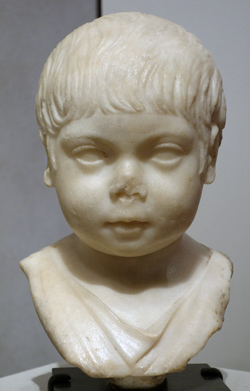
I find this two thousand-year-old letter still very moving and useful to read, regarding it as an inspiration every time I find myself in the unenviable position of having to console a family member or a friend who has lost someone important. The notion that grief is a natural human emotion that may turn unhealthy if it becomes all-consuming, or when it takes over our identity, is one to consider carefully, especially before one is struck by it, as we all inevitably are.
Plutarch’s letter shows philosophy attempting to meet us in our vulnerability and provide us with practical resources not just abstract theory. Of course, the enduring question is whether reason truly can help us in dreadful situations such as the loss of a child. I firmly believe that it can. The lasting value of Plutarch’s counsel is that we can come to see grief as something we can navigate with both heart and mind.
© Prof. Massimo Pigliucci 2026
Massimo Pigliucci is the K.D. Irani Professor of Philosophy at the City College of New York. His books include How to Be a Stoic: Using Ancient Philosophy to Live a Modern Life (Basic Books) and Beyond Stoicism: A Guide to the Good Life with Stoics, Skeptics, Epicureans, and Other Ancient Philosophers (with Greg Lopez and Meredith Kunz, The Experiment). More by him at figsinwintertime.substack.com.
Advertisement
