


Your complimentary articles
You’ve read one of your two complimentary articles for this month. To have complete access to the thousands of philosophy articles on this site, please
You can register for a free account to have four complimentary articles per month. We will occasionally email you a newsletter, from which you can unsubscribe at any time. We do not sell personal data or otherwise disclose personal information to other organisations.
Articles
Heisenberg’s Philosophy of Quantum Mechanics
Kanan Purkayastha explains how Werner Heisenberg’s 1925 paper turned the quantum theory of the early 1900s into the quantum mechanics of today.
Two theories dominated the physics of the Twentieth Century: relativity and quantum mechanics. But whereas relativity was the work of a single person (Albert Einstein), quantum mechanics has many fathers, including Werner Heisenberg, Max Planck, Max Born, Paul Dirac, Pascal Jordan, and Erwin Schrödinger. However, quantum mechanics as we know it today was triggered by Heisenberg’s lonely night on the island of Helgoland in 1925, when he invented matrix mechanics without knowing the concept of ‘matrix’. Accordingly, on June 7, 2024, the United Nations proclaimed 2025 as the International Year of Quantum Science and Technology.
On 30 July 2025, the journal Nature reported that at an event on Helgoland to mark the 100th anniversary of quantum mechanics, the Nobel Laureate physicist Anton Zeilinger claimed that “There is no quantum world”. Zeilinger opined that quantum states exist only in minds, and that they describe information rather than reality. Alain Aspect, the physicist who shared the 2022 Nobel Prize with Zeilinger, disagreed. On the other hand, Gerard T’Hooft, a Physics Nobel Laureate in 1999, mentioned in a recent interview in Scientific American that “We know superposition in the macroscopic world is nonsense. That’s clear. And I believe that in the microscopic world it’s clearly nonsense, too” (Spring/Summer 2025, p.43). This reflects deep philosophical differences among physicists about the nature of reality. How did Heisenberg think about the nature of quantum reality, then?
Heisenberg received the Nobel Prize in Physics in 1932. The Nobel Committee in Sweden summarised his work as follows:
“In Niels Bohr’s theory of the atom, electrons absorb and emit radiation of fixed wavelengths when jumping between fixed orbits around a nucleus. The theory provided a good description of the spectrum created by the hydrogen atom, but needed to be developed to suit more complicated atoms and molecules. In 1925, Werner Heisenberg formulated a type of quantum mechanics based on matrices. In 1927 he proposed the ‘uncertainty relation’, setting limits for how precisely the position and velocity of a particle can be simultaneously determined.”
So, Heisenberg’s philosophical thinking about the nature of reality in quantum mechanics revolved around matrix mechanics and the uncertainty relation. But what are they?

For more art by Cameron Gray, please visit ParableVisions.com and Facebook.com/CameronGrayTheArtist
Quantum Mechanics Emerges
In June 1925 Heisenberg went to Helgoland, a small island in the North Sea, in order to get relief from hay fever. He later mentioned that at 3 o’clock in the morning he saw the answer emerge. As he recalled in his book Physics and Beyond (1969), “I had the feeling that, through the surface of atomic phenomena, I was looking at a strongly beautiful interior and felt almost giddy at the thought that I now had to probe this wealth of mathematical structures nature had so generously spread out before me” (p.61).
On 9 July 1925, Heisenberg sent a paper titled ‘Quantum-theoretical re-interpretation of kinematic and mechanical relations’ to Max Born, whom he was assisting at that time, and Born sent the paper to the journal Zeitschrift für Physik on 25 July. It turned the quantum theory of the early 1900s into the quantum mechanics we’re familiar with today.
In it Heisenberg wrote that “the present paper seeks to establish a basis for theoretical quantum mechanics founded exclusively upon relationships between quantities which in principle are observable.” Then Born’s and Jordan’s paper titled ‘On Quantum Mechanics I’ was published (received 27 Sept 1925). In it the authors say that “the recently published theoretical approach of Heisenberg is here developed into a systematic theory of quantum mechanics with the aid of mathematical matrix methods.” On 7 Nov 1925 the same journal received a paper from Paul Dirac titled ‘The fundamental equations of quantum mechanics’. In it Dirac mentions that “In a recent paper, Heisenberg puts forward a new theory which suggests that it is not the equations of classical mechanics that are in any way at fault, but that the mathematical operations by which physical results are deduced from them require modification. All the information supplied by the classical theory can thus be made use of in the new theory.” Then on 16 November 1925, Born, Heisenberg, and Jordan submitted another paper titled ‘On Quantum Mechanics II’, saying that “the quantum mechanics developed in Part 1 of this paper from Heisenberg’s approach is here extended to systems having arbitrarily many degrees of freedom.” Two more seminal papers followed in early 1926: Wolfgang Pauli’s ‘On the hydrogen spectrum from the standpoint of the new quantum mechanics’ (received 17 Jan), and Dirac’s ‘Quantum mechanics and a preliminary investigation of the hydrogen atom’ (received 22 Jan). In the latter Dirac also acknowledges Heisenberg, writing that “a recent paper by Heisenberg provided the clue to the solution of this question and forms the basis of a new quantum theory. According to Heisenberg, if x and y are two functions of the coordinates and momenta of a dynamical system, then in general xy is not equal to yx”. After that, we get Schrodinger’s wave equations in 1926, which provided a different way to do quantum mechanics equivalent to matrix mechanics. The rest is quantum history.
Konrad Kleinknecht, in his book Einstein and Heisenberg: The Controversy Over Quantum Physics (2019), said this about matrix mechanics:
“The basic idea that Heisenberg had on Helgoland was this: to ignore completely the electron orbits and take only observable values into account, i.e., the totality of the oscillation frequencies and intensities of the light emitted by the atoms with the spectral lines measured in the spectrograph. In Göttingen, he had already tried to apply this principle to the simplest atom, but at that time this problem had appeared too difficult. Now he was searching for a simpler system by which he could handle the method mathematically. This was the pendulum, which appears in many atoms and molecules as a model of oscillation. It is characterized as anharmonic oscillation” (p.64).
In other words, Heisenberg attempts to calculate the behaviour of electrons around atoms using quantities we can observe, specifically, the frequency and amplitude of emitted light. By these means one observes the effects of electron leaps from one of Bohr’s atomic orbits to another. Heisenberg’s idea was to write all the quantities describing the movement of the electron – position, velocity, energy – no longer as single numbers, but as tables of numbers: So he created a table or matrix with the orbits of departure in their rows and the orbits of arrival in their columns. In this way the table/matrix describes the leaps of electrons from one orbit to another. Instead of having a single position for the electron, we have an entire table of possible positions: one for every possible leap. The idea was to continue to use the same equations as always, simply replacing the usual quantities (position, velocity, energy frequency of orbit, and so on) with such tables. Born and Jordan extended Heisenberg’s idea by pointing out the importance of matrix algebra for describing atomic energy transitions.
Uncertain Relations
In 1927 Heisenberg next proposed his famous Uncertainty Principle, setting limits on how precisely the position and speed of a particle can be simultaneously determined. In fact, Heisenberg originally used the German word ungenauigkeit, which means ‘inexactness’ or ‘vagueness’ rather than ‘uncertainty’. This I think is closer to the true meaning of Heisenberg’s principle than the word ‘uncertainty’. His actual words were “canonically conjugate quantities can be determined simultaneously only with a characteristic indeterminacy. This indeterminacy is the real basis for the occurrence of statistical relations in quantum mechanics” (Zeitschrift für Physik, 43,1927). It implies that the more precisely you specify the position of a particle, the less precisely you can specify its momentum, and vice versa. ‘Specify’ here means ‘specify the range of possible values’, and the range of possible values indicates the uncertainty. And the same is true, says Heisenberg, for other pairs of quantities: notably energy - time. (It’s worth mentioning here that Born’s statistical interpretation also introduces indeterminacy into quantum mechanics, for we cannot predict with certainty the outcome of an experiment to measure its position.)
There are two competing philosophical views on the uncertainty principle. In his book Dance of the Photons (2010), Zeilinger talks about the realist position of people such as Einstein, who claim that the uncertainty principle is:
“just an expression of the limits of what can be determined by measurement. Or in philosophers’ terms, the nature of uncertainty would be an epistemic one. An alternative philosophical position is to assume that the uncertainty principle is not simply a statement about what we can know; it is a statement about the nature of things. From that point of view, Heisenberg’s uncertainty principle is a statement about how things are and what features they have. It’s a statement about what exists. A philosopher would call such a position about the nature of the uncertainty principle an ontological one. From that point of view, the electron would have neither a position that is better defined than the position uncertainty tells us, nor a speed that is better defined than its momentum uncertainty. That ontological position was held by Bohr” (pp.37-38).
So, is quantum uncertainty epistemic or ontological? Is it about limits to what we can know, or about how things really are?
First, what would it mean to say the uncertainty principle is not just a limit to what we can know, but that it describes how things actually are? It would mean that an electron never has both a well-defined position and a well-defined momentum at the same time: the electron is either not at a specific place, or it does not move with a specific speed. Zeilinger himself suggests that “in a sense, the electron carries the possibilities of many velocities at the same time and the possibilities of being in many places at the same time” (p.38). This is a direct consequence of de Broglie’s idea that a ‘possibility wave’ should be associated with each quantum particle. The essential point here however is that Heisenberg’s uncertainty principle is a statement about the nature of things, not just about what we can know.
Indeterminacy has troubled physicists and philosophers alike. Konrad said that Heisenberg’s discovery of the uncertainty principle has far-reaching consequences for the philosophy of science and epistemology. Similarly, Stephen Hawking wrote in A Brief History of Time that “The uncertainty principle had profound implications for the way in which we view the world” (p.63).
Reality & The Pragmatic Approach
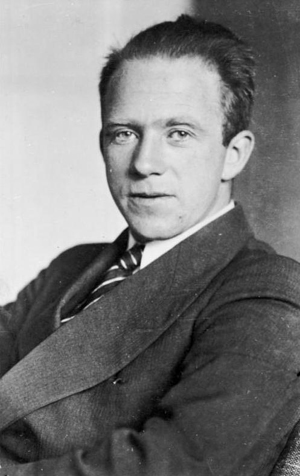
Werner Heisenberg
Heisenberg © Bundesarchiv, Bild 183-R57262 / Unknown author / CC-BY-SA 3.0
In his book Reality and Its Order (1941), Heisenberg delineates diverse areas of reality, the language used to describe them, and their order (he also mentions Goethe’s poetic ordering of areas of reality which had given him the inspiration for the essay). Heisenberg develops a six-point schema of reality and its order: Classical Physics, Chemistry including quantum theory, Organic Life, Consciousness, Symbol and Gestalt, and the Creative forces. He maintained that the order suggested by the development of natural science follows ancient patterns of thought that found ever new forms of expression at different times.
Heisenberg also remarked that “Often it takes a century of experience to produce a single new, decisive thought. Consequently, in order to answer the question what reality really is, one can hardly reply with anything other than the old fairy tale: How long does eternity last?… At the end of the world, there is a mountain, all made of diamond, and every hundred years a small bird flies there and sharpens its beak; and when the whole mountain is worn down, only one second of eternity will have passed.” (p.121).
In the Fall of 1954 Einstein’s interest was focused on the interpretation of quantum mechanics. In a meeting with him, Heisenberg claimed that “Quantum theory, with its so disconcerting paradoxes, is the actual foundation of modern physics”. Einstein responded, “But you surely don’t believe that God plays dice?” Heisenberg replied: “In quantum theory, the natural laws deal with the temporal changes of the possible and the probable. The choices that lead from the possible to the probable, however, can only be registered statistically, but can no longer be predicted” (p.163). So for Heisenberg, God does seem to play dice with the universe.
Then in his book Physics and Philosophy (1958), Heisenberg wrote that “we have to remember that what we observe is not nature in itself but nature exposed to our method of questioning” (p.25). And in his essay titled ‘The development of philosophical ideas since Descartes’ in that book, he wrote:
“The philosophic thesis that all knowledge is ultimately founded in experience has in the end led to a postulate concerning the logical clarification of any statement about nature. Such a postulate may have seemed justified in the period of classical physics, but since quantum theory we have learned that it cannot be fulfilled. The words ‘position’ and ‘velocity’ of an electron, for instance, seemed perfectly well defined as to both their meaning and their possible connections, and in fact they were clearly defined concepts within the mathematical framework of Newtonian mechanics. But actually, they were not well defined, as is seen from the relations of uncertainty” (p.46).
Heisenberg had clearly moved away from logical positivism! He further mentions that “One may say that regarding their position in Newtonian mechanics they were well defined, but in their relation to nature they were not. This shows that we can never know beforehand which limitations will be put on the applicability of certain concepts by the extension of our knowledge into the remote parts of nature, into which we can only penetrate with the most elaborate tools” (p.46). This is a pragmatic way of thinking about reality, because pragmatism, while valuing empirical evidence, focuses on the practical consequences and usefulness of knowledge, prioritizing what works best in a given situation. In Physics and Philosophy Heisenberg also referenced Kantian analytic and synthetic knowledge, and argued that the scientific method has actually changed in this very fundamental question since Kant, arguing that an analytic judgement is always a priori and that all empirical knowledge is synthetic (p.47). Like Quine, he seems not to have been a supporter of Kant’s analytic-synthetic division. In his essay ‘Language and Reality in Modern Physics’, also in Physics and Philosophy he refers to the physicist Carl von Weizsacker, who points out that one may distinguish various levels of language: “One level refers to the objects – for instance, to the atoms or the electrons. A second level refers to statements about objects. A third level may refer to statements about statements about objects etc.” Heisenberg then talks about the problem of the language of classical and quantum logics. In his words, “In classical logic it is assumed that, if a statement has any meaning at all, either the statement or the negation of the statement must be correct… Tertium non datur, a third possibility does not exist… In quantum theory this law ‘ tertium non datur’ is to be modified” (pp.124-125). He says we need to consider the third possibility: “In quantum theory, however, we have to admit – if we use the words ‘atom’ and ‘box’ at all – that there are other possibilities which are in a strange way mixtures of the two former possibilities. This is necessary for explaining the results of our experiments” (p.125). He suggests that “classical logic would then be contained as a kind of limiting case in quantum logic, but the latter would constitute the more general logical pattern.”
In his essay ‘On Books and Reading’, Arthur Schopenhauer says that “Thoughts put on paper are nothing more than footsteps in the sand: you see the way the man has gone, but to know what he saw on his walk, you want his eyes” (p.3). Indeed, we may need Heisenberg’s eyes in order to understand his philosophy.
© Dr Kanan Purkayastha 2026
Kanan Purkayastha holds a PhD in Theoretical and Atmospheric Chemistry from the University of Bristol. This essay is adapted from a lecture delivered at Göttingen University, Germany, on 9 September 2025, during a celebration of 100 years of quantum mechanics.
Advertisement
