


Your complimentary articles
You’ve read all of your two complimentary articles for this month. To have complete access to the thousands of philosophy articles on this site, please
If you are a subscriber please sign in to your account.
To buy or renew a subscription please visit Subscriptions.
If you are a print subscriber you can contact us to create an online account.
You can register for a free account to have four complimentary articles per month. We will occasionally email you a newsletter, from which you can unsubscribe at any time. We do not sell personal data or otherwise disclose personal information to other organisations.
Books
Death in a Shallow Pond by David Edmonds
Dylan Neri on Singer’s ‘drowning child’ thought experiment.
Death in a Shallow Pond (2025) by David Edmonds is the biography of an idea. That idea, delivered into the world by Peter Singer in his 1972 paper ‘Famine, Affluence and Morality’ in the journal Philosophy and Public Affairs, is the ‘Drowning Child’ thought-experiment. Singer’s basic premise is, “if it is in our power to prevent something bad from happening, without thereby sacrificing anything of comparable moral importance, we ought, morally, to do it.” In this thought experiment, you are walking past a shallow pond when you spot a small child drowning in it. If you don’t wade in and pull her out, she will die. Wading in is easy and safe, but it will ruin your new shoes. There’s no time to change them. What should you do?
From this example Singer draws an analogy for ethics in modern society: “According to Singer,” writes Edmonds, “most of us in the affluent world metaphorically walk past a shallow pond every day of our lives.” In what sense do we walk past drowning children? Well, by not donating as much as we can to “charities that operate in the developing world with a mission to help those most in need.”
A Prophet Arises
Edmonds opens with a quote from Marx: “The philosophers have only interpreted the world. The point, however, is to change it.” This is presumably meant to serve as a subtle form of suggestion – that is: “Marx? This idea must be radical!” It places Singer in a historic line of intellectuals and prophets going back to Moses, Plato, and beyond, who see their role as the benevolent shapers of primitive men, who can’t understand higher concepts of art and morality without them.
It was Mikhail Bakunin who realised in arguing with Marx long before Leninism, that if you accept the idea of humans as ‘mere historical products’ – simple reflections of their environment – it follows that there’s no moral barrier to moulding them to be anything you like. If humans don’t have any intrinsic nature – any instinct for freedom, say – then there’s no moral reason for leaving them be. Bakunin also recognised that this assumption would lead to a new class of intellectuals – ones who would realise that the best way to power is to associate yourself with a rising ruling class. These new intellectuals now include the progressive liberals of the modern age – those who believe like Walter Lippmann that in a democracy there are two classes of citizens. There are the general public, whom Lippmann calls ignorant and meddlesome outsiders who couldn’t on their own know right from wrong and must not be trusted; and there are the responsible people, the smart people, those with integrity and honour, the intellectual aristocracy (or priesthood) – who should be in charge (see Public Opinion by W. Lippmann, 1922). Singer’s ‘radical’ thinking, and by extension this book, is merely a continuation of this progressive liberalism.
Edmonds himself places the origins of Singer’s thinking in the anti-war movements of the Sixties, and defines it in opposition to the ossified state of philosophy at the time. He writes that Singer was at “the forefront of taking philosophy out of the academic world and into the real world” (crucially, Edmonds here means moral philosophy). “He,” continues the awe-inspired Edmonds, “merely made abstract philosophy accessible to the average person, stripping away the mystery, as Wittgenstein stated.” Perhaps it might equally be argued that Singer’s demystification of morality was inspired by a Moses-like figure! We learn that Singer was ‘unimpressed’ by the intuitionism of his teacher McCluskey in response to the wars in Korea and Indochina; but “Singer was particularly impressed by [Derek] Parfit” – a man who “spent the last quarter of his life determined to demonstrate that there were moral facts: that morality was objective.” Indeed, this is one of the main preoccupations of that branch of philosophy known as metaethics. But doesn’t this ambition to hand down absolute moral facts mean that metaethicists have a prophet-motive? Every figure mentioned in this book intensifies the obvious analogy with religion, which becomes almost ironic by the end – but perhaps none more so than Parfit, whose secular monasticism is worthy of a Python sketch: “He wore the same clothes every day – gray trousers, white shirt, red tie – so that he didn’t waste time selecting between outfits. He read while exercising and brushing his teeth… He made instant coffee from a hot water tap, so that he didn’t waste time boiling a kettle.” There is no reason to take these persons any more seriously than someone with a tin-foil helmet proclaiming the imminent arrival of God. Yet Singer did take these people seriously, so here we are.
Ossified Thought In Motion
Singer’s thought-experiment eventually spawned a movement called Effective Altruism. It encourages people to donate as much of their salary as they can afford to charities scientifically chosen to maximise the positive impact of donations made. This movement is (unfortunately) the main topic of the book.
The Effective Altruism movement’s founders are William MacAskill and Toby Ord, two well-raised middle-class kids, and the essential conservatism of the ideology is a result of this fact. Yet on the contradiction between this movement’s aim – maximum human benefit – and the nature of capitalism Edmonds is curiously silent, even when comment seems unavoidable. For example, in sketching the rise of the movement from the student days of Ord and MacAskill, Edmonds writes that “MacAskill eventually distanced himself from environmental politics, in part because his pragmatic approach was at odds with some of his fellow activists” (MacAskill supported carbon trading). Here Edmonds offers no opinion or analysis, writing only that this was “condemned by many of his fellow environmentalists as being a capitalist approach.” Rather, we learn that MacAskill “started donating 5 percent of his modest income – his parents were financing his living costs.”
The basic approach of Effective Altruism is encapsulated in the ‘80,000 Hours’ principle. The argument goes, if you’re clever, and therefore a suitable candidate to join the club of elite liberal intellectual and moral guardians, rather than work for a charity or anything demeaning like that, you should get a high-paying job in finance and donate your money. By using sophisticated statistical methods – that is, the cold rationality of the utilitarian calculus of benefit – it’s possible to measure which charity is most worthy of your donation, because it saves the most lives. More money for the best charity, better world, QED. In the modern economy the result of this reasoning, of course, is that most good people should work in finance.
Perhaps it’s easier to see the gaping assumptions here without a decent upbringing and a good education. The most morally unsophisticated working class single mother, who works full-time to pay for the privilege of raising her children, and whose plight might not be directly solvable by donations to some charity scapegoat, can see it most clearly. But it doesn’t need to be a radical argument against capitalism – not even anti-capitalist, in fact – to point out the cruel and immensely unequal nature of modern neoliberalism, which is itself dependent on the speculative financial economy Singer and Edmonds wants us to prop up. Edmonds offers nothing about that. Nor does he deal with the quite obvious fact that not everything can be solved by charitable donations. To which charity should the abolitionists have donated? Or the supporters of universal suffrage? Or the miners of the Rhondda Valley?
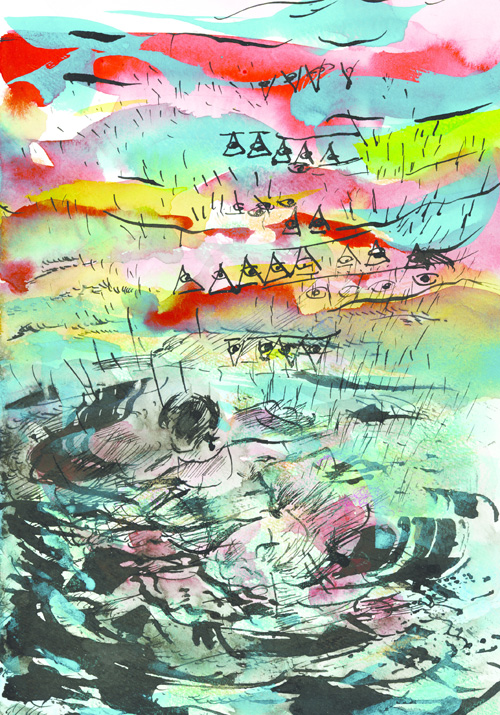
Death in the Shallows by Venantius J Pinto 202
Criticisms & Rebuttals
The second half of the book is dedicated to Edmonds responding to criticisms. But because the discussion of the book is so limited in scope, the arguments against it are only relevant within the domain of two apparent fundamental assumptions: that there is no human nature, and that capitalism is the sole guarantor of happiness – two crucial underlying premises of his argument that are not made explicit by Edmonds.
Take Edmonds’ first rebuttal – against the criticism that thought-experiments are too artificial to be applicable. Well, says Edmonds, not in this case. Why? Because children do drown every year, and we can imagine it happening. But by excluding the capitalist system from his argument, Edmonds closes down an interesting line of discussion. For instance, what causes there to be so many (metaphorically) ‘drowning’ children in the first place? Besides, from a purely utilitarian perspective such as Singer’s, surely it isn’t certain that this drowning of children might not lead to greater overall happiness, and therefore be justified? A particularly callous utilitarian might ask: Is it not better for a few million children to drown so that a few hundred million Westerners can be happy? But by the same argument, would it not have been better just to let a few million Jews die if this had brought enough happiness to enough Nazis?
The most interesting criticism is found in the chapter ‘The New White Man’s Burden: The Institutional Critique’. Edmonds quotes the ‘frequent criticism’ that “to the extent that Effective Altruism can be described as a social movement, it is in fact a movement not of struggling social workers, English teachers, or iron workers, but of wealthy (mostly white and male) capitalists, analytic moral philosophers at elite institutions, and, significantly, technologists.” What Edmonds misses though, is that the issue here is not whether “there are now more women involved” or that “the proportion of white people is decreasing, and that most people in the movement describe themselves as left wing.” Even if Effective Altruism became a wonderful mosaic of ethnic and gender diversity, it would still be an institution of Bakunin’s intellectuals, of Lippmann’s guardians, who ensure that the ignorant and meddlesome outsiders – those too stupid to know anything – remain outside. It’s no coincidence that every ‘progressive’ company, from the Financial Times to Microsoft, makes propitiations to the diversity quotas and inclusivity drives. It’s part of a carefully marketed, progressive, liberal ‘manufacture of consent’ (Lippmann’s term). This sickly consensus has become the basis of modern democracy, just as Bakunin predicted. It’s happened because if you can convince anyone who might think differently – say, poor whites, women, or ethnic minorities – that you represent the true progressive ‘left wing’, and that anything dissenting from your agenda is antithetical to progress and not worth the attention of any true intellectual, then there is no danger of revolutionary change – no threat that the meddlesome and ignorant outsiders might interfere in politics. Rather than make a fuss, anyone with the right ideas and sufficient smarts will get the right job and ensure progress continues unabashed. Or as the 80,000 Hours principle has it, get a job in high finance and donate as much money as possible.
The final chapter is a postscript about the reaction to Singer’s 1975 book Animal Liberation, in which he argued that “what made humans morally distinct from animals was not their being ‘human’ p er se” because “most of the traits that make us ‘persons’ – beings worthy of special moral status – develop slowly after human conception and are absent at the embryo stage.” Edmonds again deals with criticisms with all the enthusiasm of a true believer. Nowhere does he think it relevant in this context to discuss the nature of rights and their reciprocal relationship with responsibilities – which responsibilities animals evidently do not have. Nor does Edmonds point out the obvious hypocrisy in Singer’s two positions; namely, why do the rights of animals deserve the radical activism that is absent from the Effective Altruist doctrine? Charitable donations for suffering humans; radical civil disobedience for suffering cows. There is something morally suspect about people who value animal life over human, the vegans and animal-lovers who say, “I would rather a human die than an animal.” Perhaps this perspective can be best understood with the words of G.K. Chesterton: “where animals are worshipped, humans tend to be sacrificed.”
This, just as with the Effective Altruism cult, is nothing more than activism for the children of privilege who want the illusion of radicalism without any of the (real) sacrifice. Another pseudo-religion of the new consumer democracy. This is most likely why the movement, and Singer himself, is most popular among middle-class students on university campuses, for any true sacrifice might jeopardize their future position among the intellectual and moral guardians of society; might even mean solidarity with the human sufferers in their own communities and perhaps even the realisation that those sufferers are just as moral, maybe even just as smart, as themselves. And that they must never accept.
© Dylan Neri 2026
Dylan Neri is a writer from Newcastle upon Tyne.
• Death in a Shallow Pond, David Edmonds, Princeton University Press, 2025, £20 hb, 288 pages
Advertisement
