


Your complimentary articles
You’ve read all of your complimentary articles for this month. To have complete access to the thousands of philosophy articles on this site, please
If you are a subscriber please sign in to your account.
To buy or renew a subscription please visit Subscriptions.
If you are a print subscriber you can contact us to create an online account.
You can register for a free account to have four complimentary articles per month. We will occasionally email you a newsletter, from which you can unsubscribe at any time. We do not sell personal data or otherwise disclose personal information to other organisations.
Brief Lives
Heraclitus (c. 500 BC)
Harry Keith lets flow a stream of ideas about permanence and change.
If you’ve never read Heraclitus’s book, then you share something in common with every modern scholar of his work: we only have fragments. Unfortunately, so little of his writing survives that it is difficult to piece together the life and opinions of this intriguing philosopher. This is what makes studying him partly so easy, and partly so difficult: you can read all the surviving fragments in an hour, then puzzle over them for the rest of your life.
We may never understand Heraclitus’s philosophy in detail, but I hope by the end of this article to introduce you to some of the themes that survive, to what recent(ish) philosophers have said about them, and to what we can learn from them today.
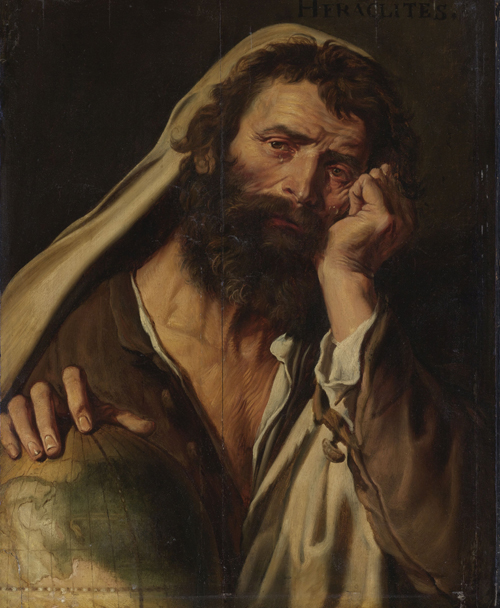
Heraclitus was known as ‘The weeping philosopher’.
…
Advertisement
