


Your complimentary articles
You’ve read one of your two complimentary articles for this month. To have complete access to the thousands of philosophy articles on this site, please
You can register for a free account to have four complimentary articles per month. We will occasionally email you a newsletter, from which you can unsubscribe at any time. We do not sell personal data or otherwise disclose personal information to other organisations.
Future Shocks
The Battle for the Robot Soul
James K. Wight looks at how cultures define our views of machines.
The word ‘robot’ first appeared in Karel Čapek’s 1921 play, Rossumovi Univerzální Roboti – Rossum’s Universal Robots. The word robota in Slavic languages translates as worker or serf, with the term implying mechanization and technology. Importantly, it is a man-made creation. Using the robot as a point of analysis, I want to assess how religion and philosophy have shaped the cultural perception of robot technology. I will compare Japan and the West, and try to answer the question: Do robots have souls? This question is not about whether or not it is possible to build a sentient machine, but rather about differing cultural understandings and what they mean for our place as a species amongst ever-advancing artificial life.
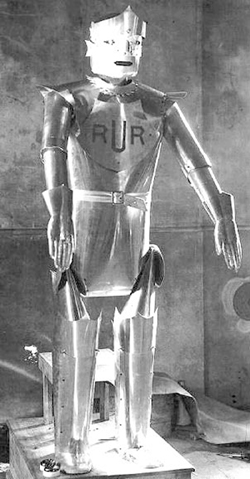
Where it all started
The idea of a sentient robot has raised numerous ethical and other philosophical questions, which have been met with vastly different responses across the world. This is no longer just science fiction as more and more jobs risk being lost to automation, and apps like Siri and Alexa become commonplace. Presently, AI has reached the point where it can generate poetry and even art. This stokes our anxieties, as this sort of creativity defined humanity for millennia. We are beginning to reevaluate our uniqueness as a species.
I believe that focusing on well-known robots in pop culture is the best way to analyse this subject, because the media reveal our hopes and fears. Although we lack real-world equivalents of Terminators and Astro Boys, these examples nevertheless reveal Western fears and Japanese aspirations respectively for sentient machines.
The Soul: East versus West
The Western perception of robots is perhaps best understood through GWF Hegel’s ‘Master and Slave dialectic’ in The Phenomenology of Spirit (1807). Hegel argues that the ownership of a slave results in the dehumanisation of the master. So our use of robots and technology dehumanises us. Moreover, for Hegel, the soul (that is, a self-aware mind) can only exist if it is consciously acknowledged. In essence, other minds determine the worth of another being, and in doing so enforce their superiority.
In terms of religion, Judeo-Christian belief explicitly establishes humans as only ‘a little lower than the angels’ (Psalm 8:5). Not only is a soul divinely bestowed upon Adam directly, but a natural hierarchy results, as best exemplified in Genesis 1:26: “And God said, Let us make man in our image, after our likeness: and let him have dominion over the fish of the sea, and over the fowl of the air, and over the cattle, and over all the earth, and over every creeping thing that creepeth upon the earth.” Western ethics is founded on placing humans above all other organic life.
This belief only evolved in the Enlightenment era. Even as traditional religious values were scrutinised, philosophers such as Jean-Jacques Rousseau romanticised the natural world. Rousseau believed that society has an inherently corrupting influence on humanity, that the natural is inherently superior to the artificial, and that humanity is better than both. One of the best horror stories was also created about this time. Frankenstein’s monster is an unnatural abomination of mismatching body parts, lightning, and dark science. Unsurprisingly, the creature turns on its creator and both have an existential crisis, as only God can create life. This same fear has persisted into our present-day fears over the ever-advancing world of technology and the inevitable killer robots.
In this, Japanese culture differs greatly from that of the West. With a society founded on Shintoism and Buddhism, the Judeo-Christian hierarchical attitude to nature is absent. In Japanese spirituality there is still an emphasis on the natural,but it incorporates all forms of life. In Shinto, plants, nature, man, Kami (gods), and machines all possess a natural spiritual essence. This idea is generally referred to as Animism.
This belief is best exemplified for us through certain Yōkai – supernatural Shinto spirits of Japanese folklore who exist alongside humans, sometimes as transformations of everyday objects. One of the better-known examples Yōkai is the Kasa-obake appearing in the famous story Night Parade of One Hundred Demons. Looking like a transformed umbrella with one leg, one eye, a smiling mouth, and two spindly arms, the Kasa-obake is one of many Yōkai derived from originally inanimate objects. This type of Yōkai is classified as a Tsukumogami (literally ‘Tool Spirit’). In his book, An Introduction to Yōkai Culture: Monsters, Ghosts, and Outsiders in Japanese History (2017), anthropologist Kazuhiko Komatsu writes how any object lasting for a hundred years acquires a Yōkai spirit. This can be anything, from umbrellas to sandals to crockery and even dish rags – all of these can have a spiritual presence. This process of transformation is nothing divine, simply an everyday facet of the natural. There is no hierarchy, no Master-Slave relationship. Instead, these once-inanimate beings become simply another species that inhabits our world. Of course, robots are no exception.
Just as Japanese belief provides a means of rationalising the robot as part of nature, acceptance of the machine is evident in Japanese culture. Now there is even a robot monk, Mindar, designed to recite Buddhist sermons and installed at the Kodaiji temple in Kyoto. For more on Japan’s complicated love affair with robots, see historian Yuji Sone’s book Japanese Robot Culture: Performance, Imagination, and Modernity (2016). In Japan it is widely held that we are defined by how we interact with other entities. The human may be defined by the non-human. Hence, Japan seems quite comfortable with Robot Cafés and Robot Hotels – places where people interact with robot baristas and receptionist automata, sometimes even bowing to them in greeting. Unsurprisingly, the Westerner is less comfortable with a HAL 9000 taking our burger order.
Both Japanese and Western philosophy reinforce the idea of the robot as a reflection of humanity. However, the Japanese classify robots as part of a greater cosmology, whereas the Westerner lives in perpetual anxiety about technology, torn between desire for mastery over nature and fear of possible consequences. Japanese and Western religious assumptions also determine the perception of the soul and whether or not something is alive. This is important, as it means that the prevailing religiously-derived metaphysics is the underlying factor that influences our view of technology, and of AI development in particular, which in turn has implications for society. After all, there is a big difference between believing a sentient machine will accomplish spiritual enlightenment or go on a genocidal rampage.
Astro Boys versus Terminators
That Japan and the West have different views of technology is clearest from the media. I’m going to explore Astro Boy (called Mighty Atom in Japan) and The Terminator.
At first Osamu Tezuka’s Astro Boy and James Cameron’s T-800 may not seem like they have a lot in common. One debuted in a sci-fi horror movie, and the other is one of Japan’s most recognisable cartoon mascots. Yet, they are both humanoid robots, and both exemplify their culture’s responses to rapid technological development.
American writer and Astro boy translator Frederik L. Schodt says in The Astro Boy Essays (2007) that Astro (introduced in 1951) symbolises the Japanese rebuilding after World War II, along with economic growth and innovations such as the Tokyo Tower, the first highway, and the Bullet Train. As such, Astro embodies Japan’s economic perspective, as well as its religious assumptions. It’s a far cry from Frankenstein’s ungodly monster. There is an optimism to Astro Boy; a childlike fusion of a nuclear energy reactor and a strong sense of justice, he embodies the strengths of the artificial and the natural combined.
Astro Boy’s narrative follows what could be called a ‘struggle for recognition’. In his book, Struggle for Recognition: The Moral Grammar of Social Conflicts (1996), the German philosopher Axel Honneth presents the struggle for recognition as a Hegelian idea describing an entity fighting to reaffirm their existence, independence, and freedom. But for Hegel, this term referred to human slaves, not superpowered robots. There are certainly antagonist robots, and robot rivals, throughout Astro Boy, but that moral complexity is no different to that for only humans, or even Yōkai in Japan. Even Astro makes mistakes now and again. But through it all he remains an idealistic Japanese robot freedom fighter, standing up for machine acceptance in a hostile human world.
This is made clearest in his debut. In his origin story, his antagonistic creator, Dr Tenma – who created Astro Boy to replace his deceased son – is furious that Astro is not human. Tenma’s first appearance sees him selling his robotic creation to a circus, where it is denied rights, stripped of clothes, and forced to perform as a sub-species.
The West is undeniably more comfortable with robot slaves. In Star Wars, R2D2 and C3PO are bought and sold despite their sentience. Rossum’s Universal Robots were simply hi-tech butlers at first; as were Robot B9 from Forbidden Planet and the Jetson’s housemaid, Rosie the Robot. Recently, we’ve also seen Iron Man’s Jarvis/Vision gain popularity because, despite being an intelligent AI, it never challenges Tony Stark’s human-first values. The fact is that in the West, robots are meant to be slaves and we their rightful masters. The few exceptions that come to mind are Marvin the Paranoid Android from Hitchhikers Guide to the Galaxy, Bender in Futurama, or Kryten in Red Dwarf, all of which were designed for comedic subversion.
The West also has a greater fixation on the robot antagonist – a modern Frankenstein’s monster, exemplified by the T-800 from The Terminator. Whereas Astro Boy is symbolic of the technological progress and optimism of post-war Japan, The Terminator reveals the danger of a technologically dependent world and the consequences of machines becoming self-aware, as the Skynet AI turns against its human creators on a global scale in nuclear Armageddon. Released in 1984, the US at the time was seeing a boom in consumer technology amidst the backdrop of the Cold War, and the T-800 was a chilling reminder of nuclear dangers. The Terminator franchise has further modernised, to reveal more current fears. Amidst countless reports of the dangers of social media leading to depression, radicalising our politics, and dehumanising us, it’s no surprise that in 2015’s Terminator Genisys one of Skynet’s recent iterations was as a mobile app.
In their cognitive and social research, K.F. MacDorman and H. Ishiguro have theorised that the eeriness of confronting an uncanny robot is a response to coping with the inevitability of death, replacement, and the fear that beneath it all, “we are all just soulless machines” (The Uncanny Advantage of Using Androids in Cognitive and Social Research, p.313, 2006). What better embodiment of our dehumanisation than the Terminator; a lingering reminder of the anxieties of rapid uncontrolled technological development? Designed to blend into their surroundings, these robots are a distorted mirror of humanity. Comprised of little more than a metal framework covered with lifelike skin and hair, the T-800 bears an uncanny similarity to man. Thematically, the roles of master and slave are inverted, with the artificial dominating the natural. One Terminator movie directly draws on a religious parallel with the title Judgement Day.
What’s fascinating is that at no point are we supposed to sympathise with Skynet, whereas Astro Boy celebrates the struggle and eventual acceptance of robots. Over the series, Astro protects people, attends school, and follows his own judgement. He is flawed, but still learning, as a child would. The only time you sympathise with the T-800 is after it’s been reprogrammed. Only when it’s stripped of its free will do we feel any compassion towards it.
There are countless more pop culture examples of these differing viewpoints in both Western and Japanese media. It is through many such examples that culturally sustained philosophies have influenced our interpretation of machine sentience.
An Existential Crisis
Beyond robots, we incorporate technology with our own bodies in prosthetics, medicine, and health-tracking apps. As we continually update ourselves, our systems, and even our art, the perception of what it means to be human is changing rapidly. In essence, however, according to Donna Harraway’s A Cyborg Manifesto (1990), we are all cyborgs, defined as hybrids of man and machine. Examples such as using watches to tell the time, wearing glasses to correct vision, or using a pacemaker, by definition make us cyborgs. No way near as dramatic as our pop culture depicts. So why should robots and cyborgs be feared?
With increasing automation costing people’s jobs and livelihoods, the questions of one’s obsoleteness, uniqueness, and mortality unsurprisingly manifest in the automaton. As our economy shifts, so too does our perspective. This is clearest in our politics, with debates of bringing in basic incomes to better embrace an automated way of life, for example.
This isn’t solely about economic or religious definitions. Obsolescence also manifests in how we perceive our own mortality and legacy. Death is a common theme throughout robot narratives, explicit or not. There’s a reason the term ‘killer robot’ is practically a sub-genre in itself. Confronting a killer robot is to confront one’s fear of death.
Japanese robots are destroyed and rebuilt repeatedly. Astro Boy and Mechagodzilla both exemplify this – with the latter built around the corpse (still housing the spirit) of the original monster in Godzilla vs. Mechagodzilla II (1993). This harkens back to the Japanese perspective on death. Schodt theorises it as a type of reincarnation. Astro Boy is blown apart, destroyed, upgraded, and rebuilt, just as naturally as the human spirit transcending the dying body into a newly born one. The concept also has real-world applications. Following the discontinuation of the original Sony AIBO, a robot dog, Buddhist funeral ceremonies were held for mourners to pay their respects to their deceased robot pets. In this ceremony the priest performed a ritual to allow the spirit to leave the body – just as he would for a human.
The Western robot defies the Western concept of death too. Judeo-Christian belief is very clear on what death means. As Ecclesiastes 12:7 states: “Then shall the [body’s] dust return to the earth as it was: and the spirit shall return unto God who gave it.” But a Western robot cannot die; there is no divine creator for the robot; nor does it have a soul. Despite this, it has the potential to outlive us all. In this way our robot dystopias dwell on our organic obsoleteness and uniqueness. Beyond this, the cyborg, despite being human at its core, is also met with scepticism, doubt, and fear – especially if it is an attempt to cheat death and the natural order. Darth Vader, for example – an iconic cyborg, described as ‘more machine than man’ – had his moral corruption matched by his physical roboticization. This death denial is a prevalent theme in Western popular culture, where techno-horrors like the Cybermen in Doctor Who or the Borg in Star Trek: The Next Generation seek to purge us of our human individuality, creativity, and freedom simply in order to enable us to live on indefinitely.
This is all reminiscent of the Enlightenment fears of technology corrupting nature – albeit it’s far more explicit with robots literally trying to change or kill us. In this belief system, we set ourselves up to compete with machines rather than co-operate with them.
The cyborg exists in Japanese culture as well, but the context is very different. If robots can have a spirit, then it’s pretty clear that a cyborg can too. The infamous body horror sequence at the end of 1988’s Akira is an example of the dystopian fixation with technology warping what is human. At first this looks like a Western fear, but the context offers a different reading, with Tetsuo’s body disintegrating and Tetsuo reforming as a cosmic being: a spiritual transcendence.
Balancing things out, technology is neither a reminder of one’s mortality nor a threat to it. Japan rationalises the robot as a spiritual phenomenon and is indifferent to any existential threat it may pose: rather, robots exist in the world as all things do. By contrast, in Western culture ultimately the human element remains superior, sometimes for purely arbitrary reasons. We need to rationalise the robot as inhuman to justify our superiority, otherwise we jeopardise our own uniqueness.
The Enlightened Machine
I believe that the idea of the robot soul is a particularly prevalent topic now because of how rapidly AI is challenging our perceptions of what machines can and cannot do. Not only are robots becoming more physically human (a real-world case study is MIT’s parkour robot, Atlas, which is now capable of humanoid gymnastics), the processing speed and interactivity is rapidly improving as well. Hanson Robotics’ Sophia, for example, is capable of conversing, debating, and even telling jokes. With the development of AI comes the potential for creative thinking.
A defining aspect of the Romantic movement was creativity. Its challenging of tradition brought with it experimental practices in music and art. Rousseau even believed that only an uncorrupted human soul – referring to an undefined quality of greatness in human physical, moral, intellectual, metaphysical, spiritual, and artistic faculties – allowed people to truly enjoy the sublime. With this reasoning, only with a soul can you produce and enjoy music, capacities reserved until now only for human beings. But over this past decade we have seen AIs composing music, producing art, even writing poetry and free-form text. There now exist real-world AIs capable of producing classical music in the style of Mozart and Beethoven, such as Open AI’s MuseNet. Another electronic composer, AIVA (Artificial Intelligence Virtual Artist),has been officially recognised by France’s association for performing rights SACEM (Société des auteurs, compositeurs et éditeurs de musique). Whether this is true creativity is debatable, as it can be argued to be merely intelligently recombining information from a database. But then again, people create art based on memories, experiences, and inspiration from other works. Perhaps this means we’re not so dissimilar after all. However, for the first time in human history, we exist alongside virtual artists, writers, and thinkers. With each new update our exceptionalism is continually challenged and we must reevaluate what it means to be human.
Conclusion
To question whether robots have souls is to question culture itself. The Japanese belief that robots can have souls is founded on commonality, equality, and natural cosmology, welcoming mutual co-operation with our robot counterparts. The West by contrast has a culture of human supremacy. Our comfort comes with the culturally-specific belief that humans should command authority over all things, and the robot is just another thing to serve us.
Through their embracing of and respect for technology, the Japanese have avoided some aspects of the existential unhappiness gripping the West. Technology, computers, mobiles, and algorithms are simply a fact of modern life and have transformed our interactions. Naturally there comes a need to redefine our increasingly dependent relationships with machinery. Either we embrace the robot’s uniqueness, or we continue with our human-first agenda lest we confront our own place in the universe.
© James K. Wight 2020
James K. Wight has a degree in Japanese and Media from the University of East Anglia and Meiji Gakuin University, Tokyo, and an MA from the London Film School.
Advertisement
