


Your complimentary articles
You’ve read all of your two complimentary articles for this month. To have complete access to the thousands of philosophy articles on this site, please
If you are a subscriber please sign in to your account.
To buy or renew a subscription please visit Subscriptions.
If you are a print subscriber you can contact us to create an online account.
You can register for a free account to have four complimentary articles per month. We will occasionally email you a newsletter, from which you can unsubscribe at any time. We do not sell personal data or otherwise disclose personal information to other organisations.
Visions of Society
The Social Contract: A License to Steal
Stephen Faison cross-examines the idea of a social contract.
According to classic social contract theory, originally elaborated by Thomas Hobbes in the Seventeenth Century, human beings begin politically unorganised, in what is called a state of nature, and society is created by people either explicitly or tacitly establishing a contract whereby they agree to live together in harmony for their mutual benefit. Social contract theorists seek to demonstrate why a rational individual would voluntarily consent to give up unlimited freedom in the state of nature and accept the limits to liberty required for civil society. These theorists agree that individuals make this exchange in order to ensure, or at least greatly enhance, their ability to survive. But these theorists define survival too narrowly, as ‘defense of life and property’. I want to argue here that the terms of any social contract must be expanded to include the provision of food, clothing, and shelter, because these are also necessary for survival. I contend that any state that fails to provide such maintenance, or at least state employment, and denies any obligation to provide either, forfeits it moral authority to pass judgment on the means citizens use to survive. As I shall demonstrate, under the terms expressed by classic social contract theory a citizen denied maintenance and/or state employment is left on his own, outside the limits of the contracted state, and therefore possesses a license to steal.
The theory that a social contract is the origin and basis of society is controversial, but the version of the theory developed by John Locke in his Second Treatise of Government (1689) influenced the Founding Fathers, and is at the heart of the Declaration of Independence. This form of the social contract explains how the state possesses legitimate authority through the consent of the people. So the notion of the social contract is woven into the political system in which US citizens live, even though no citizen was a party to any social contract. Arguments can also be made that some form of tacit agreement to obey the laws of a state is undertaken by anyone who wants to enjoy the benefits of living within any state. Understood this way, the social contract may seem quite reasonable, in principle helping a citizen to accept the state’s requirements, even though, as I will show, the contract does not live up to its promise.
Re-Examining the Contract
The classic social contract theories of Thomas Hobbes, John Locke, and Jean-Jacques Rousseau, agree in their speculation that men once lived in a presocietal state of nature. In the state of nature there is no property and no government, there is no external authority that an individual is compelled to obey, and he’s free to take from nature what he will. The state of nature is characterized by the individual’s right to do whatever he pleases, especially in matters pertaining to his self-preservation. As Hobbes argued, given that men are by nature self-interested and compete for the means of survival, and that in the state of nature there is no power to force them to cooperate, conflict is inevitable, and the state of nature is actually a state of war, or is always at risk of deteriorating into a state of war. The individual must combat the hostile elements as well as armed strangers, so life in the state of nature is precarious. People escape this predicament through a social contract that promises to vastly improve the individual’s ability to survive. The contract recognizes that the individual possesses a natural right to survive that is universal and inalienable. Under the terms of the social contract, each member agrees to surrender his or her natural right to use any means they deem necessary and useful to defend life and possessions, and the state assumes responsibility for protecting their person and goods, and receives authority from the people to perform this duty.
If we are to support this contract, we should be able to confirm that the individual has made a good deal for himself in this exchange of natural liberty for state-provided security. As survival was his sole motivation to surrender his power and accept the authority of the state, for this transfer to be in his best interest he must be significantly better able to survive in civil society than he was in the state of nature. Indeed, the individual’s chances of survival must be increased or enhanced to the extent that he is compensated for the loss of his natural liberty to do as he pleases and to take what he pleases without regard for others.
However, since the social contract recognizes the individual’s natural right to survive, and since without food, clothing, and shelter, the individual will not survive, it is clear that the terms of any binding social contract cannot be limited to protection of person and property, as they do in classical versions of the theory, but must include the provision of food, clothing, and, shelter, or the employment to obtain them. If the state should decline to furnish these necessities, the member must retain the same rights he would have were the state to decline to provide protection of person and property. Hobbes, Locke, and Rousseau agree that if the commonwealth fails to perform its role in delivering security, the contract is broken. The member is effectively returned to the state of nature in which he is compelled to rely on himself, and is therefore authorized to use any means he deems necessary and useful to secure his survival, and he’s the sole judge of what’s necessary and useful. It is only because the state agrees to render these survival services to its members that the member is no longer authorized to exercise his natural rights to secure his survival. Therefore if the state refuses to give food, clothing, and shelter, and also disavows any obligation to provide employment, leaving members on their own to secure their maintenance or to hunt for work, then the member is in effect left to fend for himself, and the state no longer has legitimate authority to pass judgment on the means used by ex-members now responsible for their own survival, even if the means include that which the state’s laws prohibit.
Now if conditions in the state of nature were such that adequate food, clothing, and shelter could be obtained through unexceptional industry by ordinary persons, and the barriers to obtaining them were continuous dangerous threats to one’s life and possessions by other persons, then increased or enhanced protection of life and property by the state would seem sufficient to enable individuals to survive through their own efforts. But if both in the state of nature and in civil society life remains a continuous struggle to maintain an ample flow of material necessities, then increased security does not by itself improve conditions to the extent that the individual is significantly better able to survive. In effect, the individual is not really better off than he was in the state of nature, because by accepting the terms of the social contract he has surrendered his liberty to do as he pleases in return for a security that provides no assurance against starving or freezing to death. So this is not a good deal.
Classic social contract theories do agree that life in the state of nature was indeed a continuous struggle, so we must consider whether the struggle continues under the contract.
If the only way to obtain life’s necessities for the overwhelming majority of a state’s members is to sell their labor in the market, then life for the overwhelming majority does remain a continuous struggle to survive, because any time the individual is without employment they’re without the means to survive. Under such a system, members are subject to the insecurity of economic cycles of boom and recession, with the associated periodic inflation and unemployment. Members are also subject to the authority of those who determine whether they receive employment, and must conform to whatever standards are set by the employer class. These circumstances place members in a competition for jobs. Once a job is obtained, the employee remains in a state of anxious instability, aware that employment could be terminated at any time. The individual is especially vulnerable if the state provides only a feeble social safety net, or none at all.
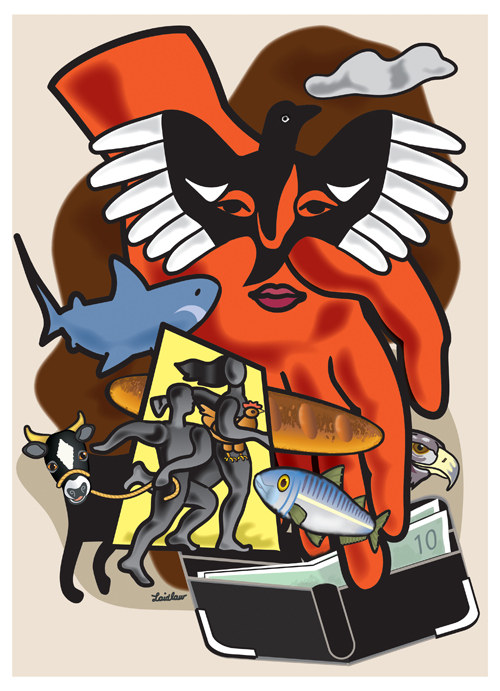
The New Social Contract © Ken Laidlaw 2016. Please visit www.kenlaidlaw.com to see more of Ken’s art.
Double Standards
Defenders of the state’s decision to regard protection of persons and property as essentials while leaving members to their own devices when it comes to food, clothing, and shelter, assert that society is not obligated to provide the material goods of survival, but only to create and enforce conditions that allow individuals to provide these themselves – it’s an opportunity society rather than a welfare state. Once security of life and property is provided, they claim, society has performed its duty: people are now free to live as they please without fear of attack.
Yet one cannot fail to notice that the opportunity society does not take the same attitude toward the protection of person and property that it takes toward the acquisition of food, clothing, and shelter. The opportunity society does not create and enforce conditions that allow individuals to provide their own protection for themselves and their property. Instead it says, “Do not take matters into your own hands, do not resort to any and all means to protect yourself and your goods, but transfer your authority to us, and though we cannot guarantee that you will never be harmed or robbed, we will make every good faith effort to provide defense for your life and property. You will be better off, and so will we all.” Even acknowledging the importance to survival of protection of person and property, to be consistent the opportunity society would choose the role of facilitator rather than of provider of those things too. It could say, “We do not accept that it is our obligation to defend your life and protect your property. The government will facilitate your efforts to secure a variety of weapons and self-defense training. By providing weapons and training, the government creates conditions that better allow each member to defend him- or herself.” But the crafters of this statement would have to recognize that this condition resembles the state of nature. Here it was agreed that if the individual is alone responsible for his personal safety, he cannot be expected to refrain from any and all means he deems necessary and useful for self-defense. But in this case, what is the point of the contract?
Conversely, the social contract might take the same approach to food, clothing, and shelter as it does to the protection of person and property. Then the government could say, “Do not take matters into your own hands, do not resort to any and all means to secure material goods, but transfer your authority to us, and though we cannot guarantee that you will never be without adequate food, clothing, and shelter, we will make every good faith effort to provide you with these necessities. You will be better off, and so will we all in our society.” Instead, the social contract takes a position with regard to food, clothing, and shelter that it does not take with regard to protection of person and property. The government says, “We do not accept that it is our obligation to provide to you food, clothing, and shelter. This responsibility falls to each individual. By prohibiting stealing and killing, the state creates conditions that better allow each member to pursue food, clothing, and shelter for him- or herself.” But the crafters of this position must recognize that this condition too resembles the state of nature in many ways; and so they must agree that as long as an individual is alone responsible for his survival, he may resort to any and all means he deems necessary and useful for it, including stealing and killing. In other words, the government’s authority to regulate someone’s behavior rests on its acceptance of a responsibility to provide the material goods to enable their survival. The government should also recognize that neither society nor the individual benefits when any and all means are employed to secure these necessities. The desperado lacking food and shelter may be tempted to employ any and all means necessary to get them, if the available options are to either die peacefully or take what he needs by force. By providing protection for persons and goods, the state offers an alternative to the violence that existed in the state of nature for the individual less able on his own to protect his life and his property. However, by not providing food, clothing, and shelter, the state does not offer an alternative to violence for the individual who cannot otherwise obtain them.
Given that the purpose of people aggregating their power was to combat forces that made survival precarious in the state of nature, a social contract might have created a commonwealth – a society for the common good – in which individuals unite, and through their collective effort procure, produce and distribute the necessities of life: food, clothing, and shelter, as well as security for person and property. But it seems that the original social contracts were instead conceived for the purpose of deterring violence and theft while leaving intact the intense competition for material goods. In this circumstance the transition from the state of nature to civil society means the conversion of nature into property, and a person is no longer able to simply pluck from nature what he needs. If competition remains the means by which individuals will or will not survive, then this social contract creates incentives for individuals to gain advantage over fellow members. This contract benefits the individual desirous of more than an equal share of material goods, and who by aptitude and temperament is ready, willing, and able to engage in the state-defended struggle for survival. He has exchanged a condition in which others could seize his surplus for one in which the state defends, in word and deed, his accumulated property and wealth. He has exchanged a playing field in which “force and fraud are the two cardinal virtues,” as Hobbes put it, for one in which cunning and guile are advantageous character traits.
This contract does not benefit the individual without possessions. He has not gained protection for his property, as he has none, but he has also lost access to whatever natural material goods have been claimed as property by ambitious others. The contract also does not benefit the individual who by aptitude and temperament is less ready, willing, and able to engage in the competitive struggle for survival. It is true that he had to compete in the state of nature; but that struggle was with nature, and sometimes other individuals who had no more entitlement to the materials of survival than he had. Now he must struggle both against nature and against those accumulating property under the protection of the state. So the social contract does not benefit the individual who does not desire more than an equal share of material wealth. He has exchanged a condition in which he could be content with the minimum needed to subsist for one in which he must keep pace with others lest they use their affluence against him.
An individual without valuable possessions or an acquisitive disposition would therefore be well advised to reject the social contract. But if he agrees to this covenant, he is still not obliged to submit to the authority of the state in matters pertaining to his survival that the contract does not cover, especially with regard to the pursuit of food, clothing, and shelter. The member agrees to forfeit his power to defend himself and his property using any means he deems necessary and useful only because the protection offered by the state is better than the protection he can give himself. Similarily, he should not agree to forfeit his power to pursue material necessities unless the maintenance provided by the state is better than that he can get for himself. Clearly, if the state does not provide these necessities, and disavows any obligation to do so, the member is well advised not to forfeit his individual power and natural right to obtain them.
An Analogy
I submit that the relationship between the commonwealth and the individual under the social contract resembles a relationship between parents and their adult daughter once again living in their home. Outside the home the daughter confronted the competitive struggle to survive, and after spending some years of freedom living on her own in a dangerous city, she has concluded that her odds of survival are much greater in her parents’ home. They may establish a curfew and other restrictions that are not generally imposed upon an adult, and the daughter is obligated to obey her parents because they have accepted responsibility for her welfare. Although she is a free adult, she allows her parents to regulate her behavior in return for providing food, clothing, and shelter. The daughter seems to have made a good deal for herself here, because she is better able to survive with her parents’ support than on her own. The parents have also made a good deal – they will provide support, but in return they regain authority over their daughter, and save themselves from worrying about her. If they ever decide to kick her out, as is their right, and she is again to be left on her own to support herself, then the parents have no power over their daughter, and she has no obligation to obey them. If it should then come to pass that the daughter steals food, or money for food, shoplifts clothing, or breaks into a dwelling to gain shelter, her parents have forfeited their moral authority to judge their daughter’s efforts to survive.
Let us take matters a step further, and imagine that the daughter, disinclined to enter the competitive struggle to survive outside the home, offers to perform work on the property in return for the maintenance she receives. The parents refuse the deal, but not because there is no work to be done. They take the position that it is not their responsibility to provide work for their daughter – their role is to prepare her to fend for herself out there. Here the parents seem to be saying, “We will not provide maintenance, and we will not provide you a job. You must go out there and find one, and if you cannot, too bad for you.” So if it should come to pass that the daughter performs in a strip-club, deals narcotics, or steals what she needs to survive, her parents have surrendered their parental and moral authority to judge their daughter’s actions.
Summary
A morally-binding social contract must provide the means to food, clothing, and shelter. The state that insists that its role is not to provide these necessities, but merely to facilitate the means for individuals to secure them, could do this by providing state employment or income. Conversely, the only reason, it seems, for a wealthy state to deny maintenance or state employment is a determination to require the majority to hunt for work and keep them in a perpetual struggle for survival. In effect, the state kicks its daughter out of the house, and she must now fend for herself. But in doing so, like the parents in the analogy, the state forfeits its moral authority to pass judgment on its ex-members’ efforts to survive. Under the terms of the social contract, these ex-members retain or reclaim their right to all things, and are now justified to resort to any and all means they deem necessary and useful to get what they need to survive, and are the sole judges of what is necessary and useful, too. They have a license to steal.
© Prof Stephen Faison 2016
Stephen Faison is a professor in the Philosophy and Religion Unit at Florida A&M University. His publications include Existentialism, Film Noir, and Hard-Boiled Fiction (Cambria Press, 2008).
Advertisement
